Tuesday, January 14, 2020

Economist Ross Garnaut failed to account for Australia's massive, proven capacity as a global climate sink, and the probability of catastrophic bushfires that can arise from mismanaging that asset: Government cannot ignore basic carbon accounting if it wants to combat climate change

by Ganesh Sahathevan


Ross Garnaut


While the economist Ross Garnaut continues to be promoted as the man who foresaw the bush fires we are witnessing  it appears that there are  some glaring accounting omissions in his work in  addition to the  problems with his modelling described on this blog.As mentioned, his target of 450 ppm by 202 has been achieved with the need for his expensive policy recommendations.

In 2014  CSIRO research published  in the scientific  journal Nature demonstrated how the heavy rainfalls experienced in 2011 had turned Australia into a " giant green global carbon sink".

According to CSIRO:

Land and ocean carbon sinks absorb around half of the world’s emissions from burning fossil fuels each year, which helps to slow the rise of atmospheric carbon dioxide concentrations from human activities.

This massive rain event was so significant that sensors on-board the twin satellites GRACE estimated a decrease in ocean water mass of 1.8 trillion tons. That remarkable finding was measured by changes in the Earth’s gravitational field, brought about by the transfer of water from the ocean to the atmosphere and land surface.
This made the ocean’s sea level fall by 5 millimetres from the beginning of 2010 to mid-2011, going against the average sea-level rise of 3mm a year over the previous 18 years associated with global warming.
Australia played a major role in this sea-level fall, for several reasons. It was partly due to vast amounts of rain that fell over Australia. The continent’s hydrological characteristics also played a role, with large impediments for rainfall to flow quickly back to the ocean, such as the large continental interior basins.
As a result of the unusually heavy rains, the Earth’s vegetation “greened” in 2011 in ways not measured over the previous 30 years, particularly in the Southern Hemisphere dryland ecosystems.
This global greening was detected by satellites, which observed increases in canopy foliage extent and vegetation water content, which both imply vegetation growth.
Combined, these measurements indicated that the world’s annual production of new plant matter significantly increased in 2011 when compared to the previous decade.

However, CSIRO also warned:
While we might see more carbon stored in new vegetation growth and soil when extra water is available in semi-arid regions, as happened in 2010-2011, the risk is that more fires and droughts would end up rapidly releasing that carbon back to the atmosphere.
It is likely that the large carbon uptake during 2011 was short-lived, as suggested by a rapid decline of the sink strength in 2012. Future research will be able to confirm if this was the case.
Arid and semi-arid regions currently occupy 40% of the world’s land area. More work is urgently needed to research the best ways to manage these areas, and whether we can increase their soil and vegetation carbon stores as part of our climate mitigation efforts.
While tropical forests like the Amazon remain vitally important as major carbon sinks, this new study and others indicate that semi-arid regions like Australia will also play a growing role in the Earth’s carbon cycle.
Increasingly, semi-arid regions are driving variability in how much carbon dioxide remains in the Earth’s atmosphere each year. And that has major implications.
Regions in the Southern Hemisphere including Australia, southern Africa, and temperate South America contributed 80% of the change, especially their savannas and other semi-arid areas.
That winter, June to August 2011, Australia was the greenest that it has ever been seen in the satellite period (since 1982).

In accounting terms the 2011 rains created an asset, a carbon sink, that Australia gained for a number of reasons but the sheer size of the continent meant  that this was, in resource terms, a world class asset. The creation of that asset was clearly not a one-off; Australia regularly experiences periods of greening and drought. 

Despite that fact, Garnaut, himself an economist, seems to have failed  to account for Australia's carbon dioxide uptake when recommending that Australia go for zero carbon dioxide emissions by 2050.This is basic carbon accounting that has been ignored.

This failure to account for the carbon uptake has resulted in what is likely to have been a gross overestimation of Australia's net carbon emissions . Worse, there has been a failure to manage a national resource which has probably resulted in the bush fires that Garnaut says he had predicted 12 years ago.
END


Record rains made Australia a giant green global carbon sink


22 May 2014

 9 minute read
Record-breaking rains triggered so much new growth across Australia that the continent turned into a giant green carbon sink to rival tropical rainforests including the Amazon, our new research shows.
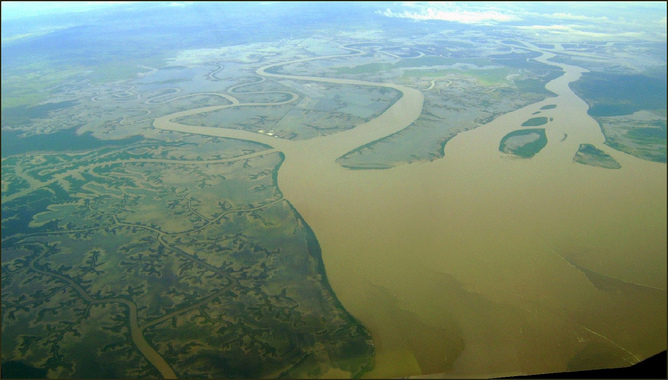
The swollen Fitzroy River in Queensland, Australia, where heavy rains in early 2011 led to extraordinary regrowth with a global impact. Capt. W. M. & Tatters/Flickr, CC BY-NC
The swollen Fitzroy River in Queensland, Australia, where heavy rains in early 2011 led to extraordinary regrowth with a global impact. Image: Capt. W. M. & Tatters/Flickr, CC BY-NC
Published in the international journal Nature, our study found that vegetation worldwide soaked up 4.1 billion tons of carbon in 2011 – the equivalent of more than 40% of emissions from burning fossil fuels that year.
Unexpectedly, the largest carbon uptake occurred in the semi-arid landscapes of Australia, Southern Africa and South America.
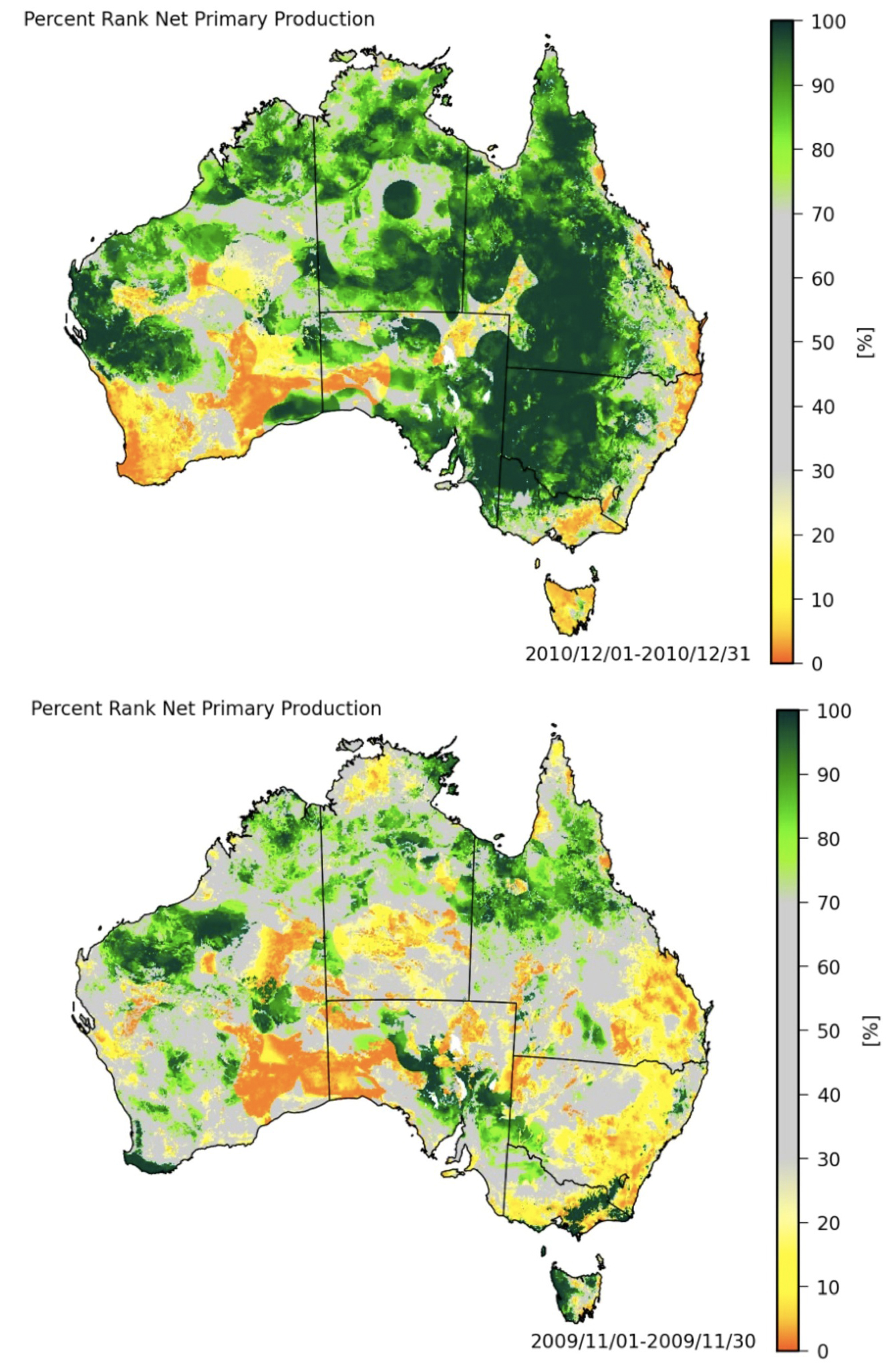
The modelled net carbon uptake of the Australian landscape in December 2010 at the start of the big wet (top), compared with December 2009 (bottom).
It set a new record for a land-based carbon sink since high-resolution records began in 1958, in a remarkable example of ecosystems working to stabilise the Earth’s climate.
And that had a global impact. While atmospheric carbon dioxide still rose in 2011, it grew at a much lower rate – nearly 20% lower – than the average growth over the previous decade.
Almost 60% of the higher than normal carbon uptake that year, or 840 million tons, happened in Australia. That was due to a combination of factors, including geography and a run of very dry years, followed by record-breaking rains in 2010 and 2011.
Yet our research raises as many questions as it answers – in particular, about whether the Earth’s natural climate control mechanisms could prove even more volatile than previously thought.The rain that made the world’s ocean fall
From October 2010 to March 2011, an extraordinary rainfall event occurred over most of Australia, which resulted in three-quarters of Queensland being declared a flood disaster zone – an area as big as France, Germany and Italy combined.
The 2011 La Niña: So strong, the oceans fell. Boening et. al. (2012), CC BY
The 2011 La Niña: So strong, the oceans fell. Image: Boening et. al. (2012), CC BY
Averaged across Australia, the Bureau of Meteorology recorded rainfall of 703 millimetres for 2010 and 708 mm for 2011. That was well above the long-term average of 453 mm for the period of 1900 to 2009.


Excess rain reached most parts of the continent, in what proved to be the wettest two years combined since national climate records began in 1900.
Queensland was the worst affected area, with 35 people killed in floods that broke more than 100 river height records, and damaged 30,000 homes and businesses in cities and towns including Brisbane, Ipswich and Toowoomba. (You can see ABC News images of Brisbane before and after the floods here.)
The big rainfall event was part of a global phenomenon called the El Niño Southern Oscillation (ENSO), which reflects atmospheric pressure changes across the tropical Pacific Ocean, in its La Niña phase.
It brought above-average rainfall not only to Australia but also to other parts of the world, particularly in southern Africa and northern South America.

The power of La Niña to evaporate water from the oceans was boosted by the ongoing high sea-surface temperatures that are part of a long-term trend of ocean warming. That trend has been shown to be associated with the release of greenhouse gases from the combustion of fossil fuels and deforestation.
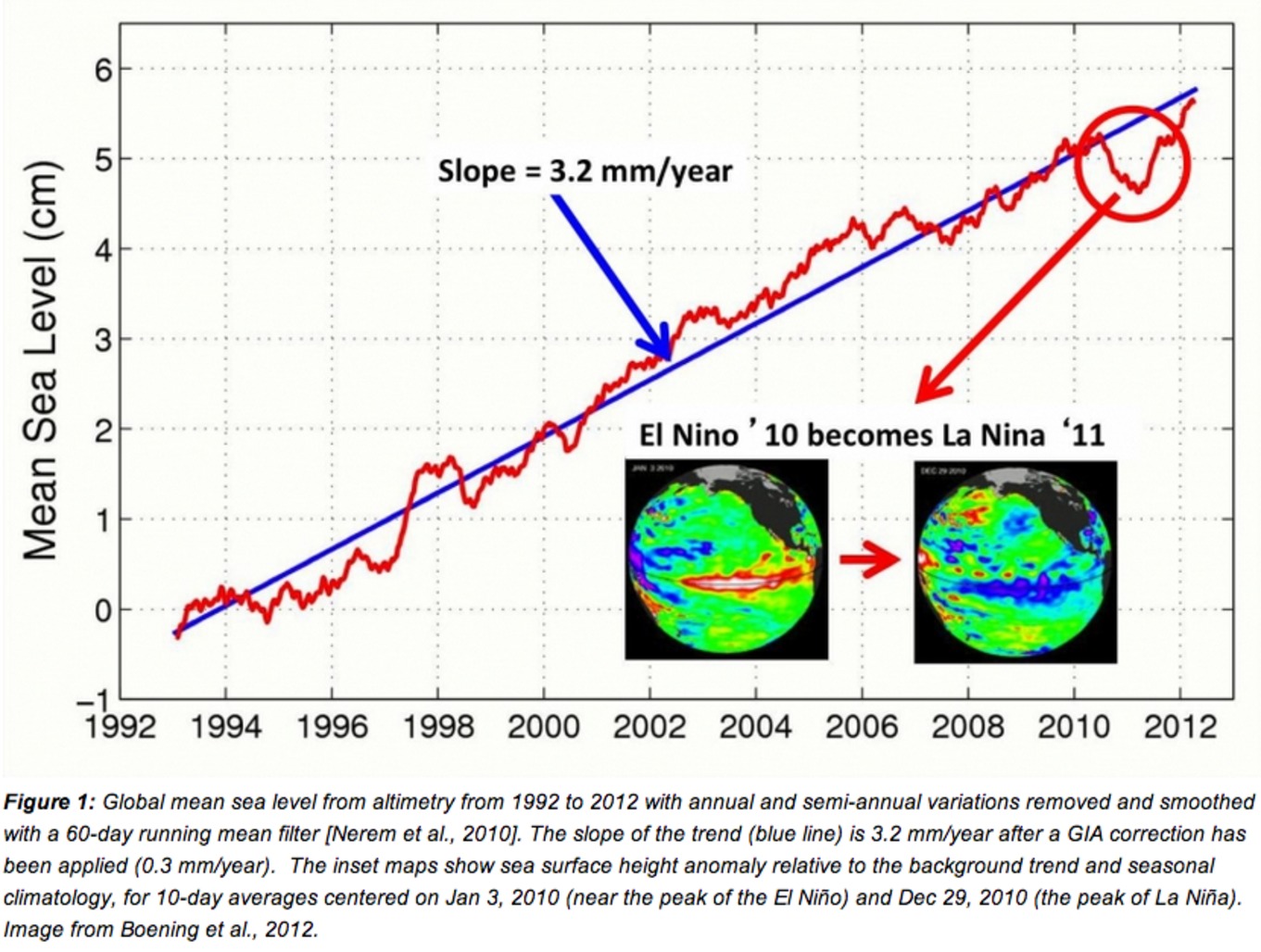
The drop in global sea level in 2011, which went against the trend of the previous 18 years. Boening et. al. (2012), CC BY
The drop in global sea level in 2011, which went against the trend of the previous 18 years. Image: Boening et. al. (2012), CC BY
This massive rain event was so significant that sensors on-board the twin satellites GRACE estimated a decrease in ocean water mass of 1.8 trillion tons. That remarkable finding was measured by changes in the Earth’s gravitational field, brought about by the transfer of water from the ocean to the atmosphere and land surface.
This made the ocean’s sea level fall by 5 millimetres from the beginning of 2010 to mid-2011, going against the average sea-level rise of 3mm a year over the previous 18 years associated with global warming.
Australia played a major role in this sea-level fall, for several reasons. It was partly due to vast amounts of rain that fell over Australia. The continent’s hydrological characteristics also played a role, with large impediments for rainfall to flow quickly back to the ocean, such as the large continental interior basins.
And Australia was a country in need of a big drink. The parched continent was emerging from a multi-year drought, particularly in the south-east region, meaning the land acted as a huge sponge, soaking up the heavy rainfall.

Seeing the Earth change colour from above
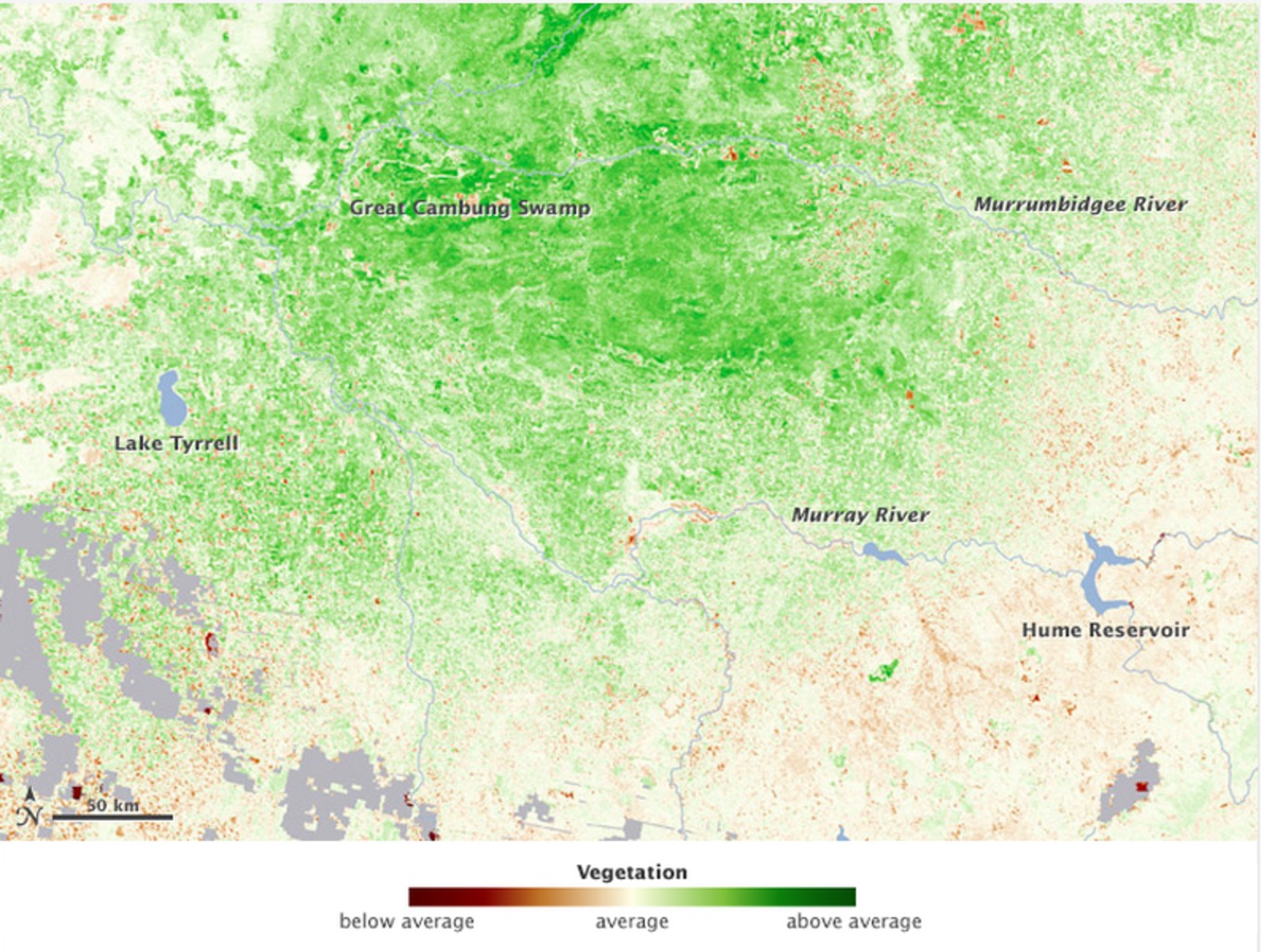
New growth springing up around the Murray River, Hume Reservoir and Lake Tyrrell in south-eastern Australia, September 2010. NASA, CC BY-NC-ND
New growth springing up around the Murray River, Hume Reservoir and Lake Tyrrell in south-eastern Australia, September 2010. Image: NASA, CC BY-NC-ND
As a result of the unusually heavy rains, the Earth’s vegetation “greened” in 2011 in ways not measured over the previous 30 years, particularly in the Southern Hemisphere dryland ecosystems.
This global greening was detected by satellites, which observed increases in canopy foliage extent and vegetation water content, which both imply vegetation growth.
Combined, these measurements indicated that the world’s annual production of new plant matter significantly increased in 2011 when compared to the previous decade.
Regions in the Southern Hemisphere including Australia, southern Africa, and temperate South America contributed 80% of the change, especially their savannas and other semi-arid areas.
That winter, June to August 2011, Australia was the greenest that it has ever been seen in the satellite period (since 1982).
Our new study in Nature also shows how fire emissions – normally a big factor in reducing Australia’s capacity to store carbon – were suppressed by about 30%, contributing even further to the continent’s greening.
The same region in September 2006. This and the image above show how growing conditions compared to average mid-September conditions over 2000 to 2011. See more images here: http://1.usa.gov/RSMka6 NASA, CC BY-NC-ND
The same region in September 2006. This and the image above show how growing conditions compared to average mid-September conditions over 2000 to 2011. See more images here: http://1.usa.gov/RSMka6 Image: NASA, CC BY-NC-ND
In addition to the unprecedented vegetation greening of Australia during 2010 and 2011, we also observe a greening trend over the continent since 1980s, particularly during the months of the Australian autumn (March, April, and May).
That has happened for a number of reasons, including increased continental rainfall over the past few decades; plants growing in an atmosphere with increasing carbon dioxide using water more efficiently; and changes in land management such as fire suppression, expansion of invasive species, and changes in livestock grazing that have led to more woodland.

The upsides of going green

Despite recurrent drought conditions in some regions, there is a current greening trend over Australia.
Overall, satellites show Australian landscapes are greener now than they have been over the past 30 years.
A greener Australia has a number of environmental and other benefits, including better protection for soils, increased soil-water holding capacity and soil fertility, and more plant feed to sustain larger animal populations.
However, more vegetation can lead to less water being available to replenish water tables and feed rivers, even though Australia loses more than 50% of all the rainfall to the atmosphere as soil evaporation, without contributing to vegetation growth.
This is in sharp contrast to temperate and tropical ecosystems, where a large part of the water is returned to the atmosphere via vegetation.

Fire, drought and rapid carbon release

However, we now need to consider whether this growing accumulation of carbon in semi-arid regions of the Southern Hemisphere could become a future climate liability through fire and drought.
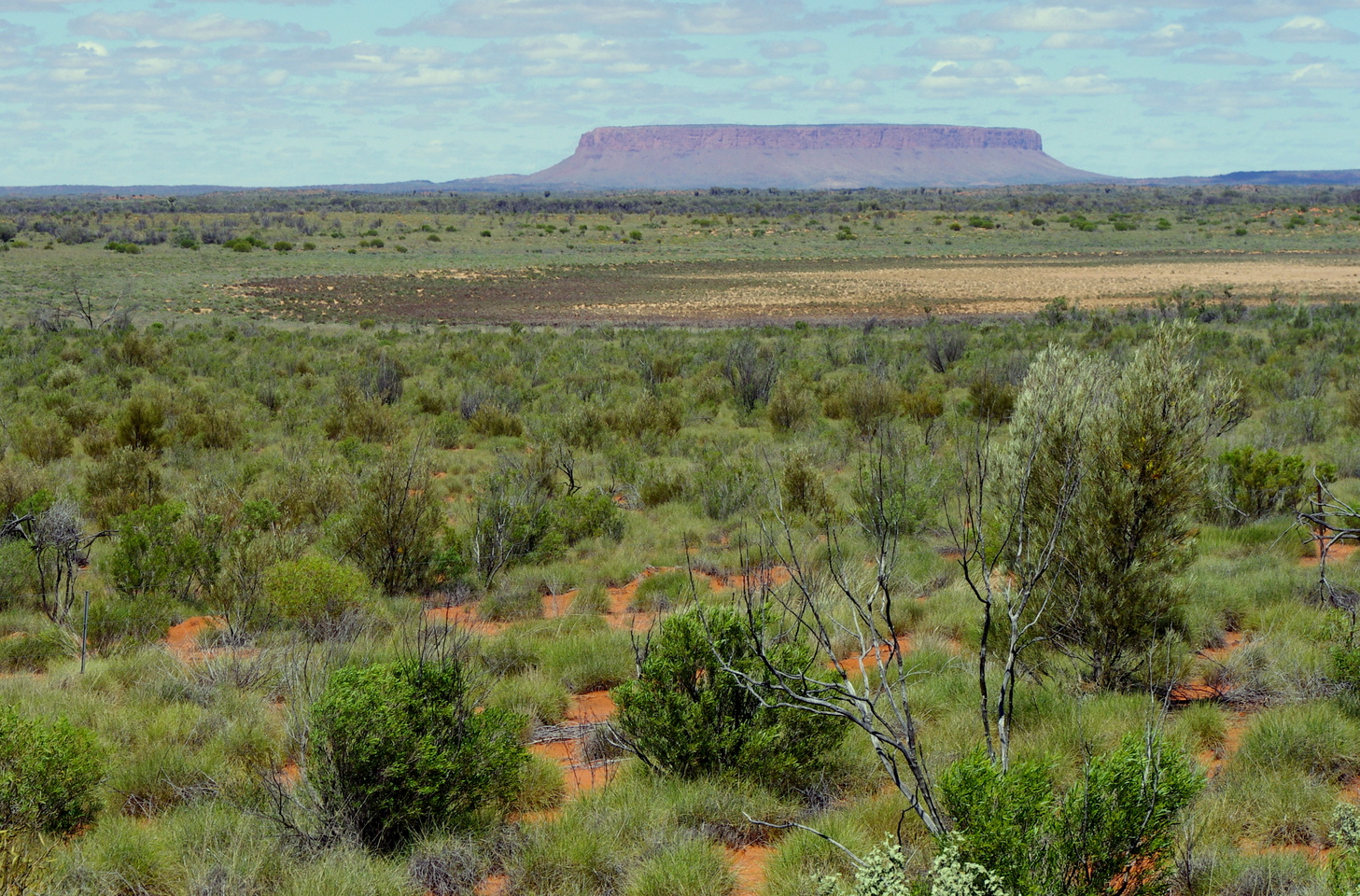
Green growth flourishing in central Australia, 2011. Eva van Gorsel, CC BY-NC-ND
Green growth flourishing in central Australia, 2011. Image: Eva van Gorsel, CC BY-NC-ND


Land and ocean carbon sinks absorb around half of the world’s emissions from burning fossil fuels each year, which helps to slow the rise of atmospheric carbon dioxide concentrations from human activities.
The Intergovernmental Panel on Climate Change’s Fifth Assessment Report found that we are likely to see an increase in climate variability that includes drier, more fire-prone conditions across large parts of the Southern Hemisphere’s semi-arid regions, including Australia.
That’s a vital trend to consider, because it could lead to a more vulnerable global carbon reservoir.
While we might see more carbon stored in new vegetation growth and soil when extra water is available in semi-arid regions, as happened in 2010-2011, the risk is that more fires and droughts would end up rapidly releasing that carbon back to the atmosphere.

Looking ahead

It is likely that the large carbon uptake during 2011 was short-lived, as suggested by a rapid decline of the sink strength in 2012. Future research will be able to confirm if this was the case.
Arid and semi-arid regions currently occupy 40% of the world’s land area. More work is urgently needed to research the best ways to manage these areas, and whether we can increase their soil and vegetation carbon stores as part of our climate mitigation efforts.
While tropical forests like the Amazon remain vitally important as major carbon sinks, this new study and others indicate that semi-arid regions like Australia will also play a growing role in the Earth’s carbon cycle.
Increasingly, semi-arid regions are driving variability in how much carbon dioxide remains in the Earth’s atmosphere each year. And that has major implications for the long-term, including whether future climate change will slow down or accelerate further.
Pep Canadell receives funding from CSIRO and the Department of the Environment. This article is based on a new paper that he was a co-author of: Poulter, B, D Frank, P Ciais, R Myneni, N Andela, J Bi, G Broquet, JG Canadell, F Chevallier, YY Liu, SW Running, S Sitch and GR van der Werf. 2014. The contribution of semi-arid ecosystems to interannual global carbon cycle variability, Nature. Canadell’s contribution was supported by the Australian Climate Change Science Program.
This article was originally published on The Conversation. Read the original article.


Monday, January 13, 2020

Ross Garnaut is Australia's version of Lim Chong Yah-Australians can learn from Singapore how best to deal with economists pre-occupied with their models

by Ganesh Sahathevan


Ross Garnaut


AsiaTimes.com.sg reported in 2012:

PM Lee rejected Prof Lim Chong Yah's "shock therapy" idea, explaining that it was better to apply sustainable measures.
Mr Lee was responding for the first time to the recent proposal for "shock therapy" by the well-known economist and former chairman of the National Wages Council, Professor Lim Chong Yah, to raise wages of the lowest-income workers by 50 per cent over three years.

Mr Lee said: "I appreciate his good intentions, I share his concerns over this group of workers. But I do not agree with his drastic approach because the only realistic way to move is step by step, with wages and productivity going up in tandem...as fast as we can, as fast as it's possible."
Mr Lee disagreed with the proposal, pointing to the 1980s when Singapore pushed up wages sharply and had "room" to do so. He said: "But even then, we ran into problems."

Mr Lee explained that in the 1980s, Singapore's economy was growing rapidly at 8 to 10 per cent a year. It also helped that the country's only competition then came from the "three little dragons" - South Korea, Hong Kong and Taiwan. China and India were not on the scene, he added.
And during that period, the labour market was tight as multinational companies such as Philips entered the labour market, creating thousands of jobs.

He said: "In 1985, when the winds changed, when the conditions turned difficult, we plunged into a very deep recession...We had to cut wages sharply...so that the economy could recover."


Left unsaid is the fact that the architect of the 1980s wage increase was the same Lim Chong Yah.


So too in Australia, where one Professor  Ross Garnaut is being promoted as a modern day Old Testament prophet, who foresaw ten years ago that the "trend" towards more intense bushfires would become evident in 2020. Left unsaid is the fact that the same man is responsible for the zero tariifs policy of the 1980s, which has seen manufacturing in Australia decimated, and Australia becoming an importer of cheap, low quality goods from China.

Like PM Lee in 2012,  PM Morrisson ought ot remind the Australian public of Proefssor Garnaut's record.

END


TO BE READ WITH


Carbon dioxide 8% BELOW Australian climate expert Ross Garnaut's saftey threshold so what's causing the Australian bushfires? If Garnaut's proposals had been implimented trillions would have been lost for nothing

Sunday, January 12, 2020

Carbon dioxide 8% BELOW Australian climate expert Ross Garnaut's saftey threshold so what's causing the Australian bushfires? If Garnaut's proposals had been implimented trillions would have been lost for nothing

by Ganesh Sahathevan


Australia's SBS and others have been reporting the following for the past month and a half:

Twelve years ago, economist Ross Garnaut led an independent study of the impacts of climate change on the Australian economy.

The Garnaut Climate Change Review's final report said projections of fire weather "suggest that fire seasons will start earlier, end slightly later, and generally be more intense".

"This effect increases over time, but should be directly observable by 2020."

Garnaut's recommendations, as summarized by The Guardian:

The Garnaut report says developed nations including Britain, the United States and Australia would have to slash carbon dioxide emissions by 5% each year over the next decade to hit the 450ppm target. Britain's climate change bill, the most ambitious of its kind in the world, calls for reductions of about 3% each year to 2050.

Garnaut, a professorial fellow in economics at Melbourne University, said: "Achieving the objective of 450ppm would require tighter constraints on emissions than now seem likely in the period to 2020 ... The only alternative would be to impose even tighter constraints on developing countries from 2013, and that does not appear to be realistic at this time."

The report adds: "The awful arithmetic means that exclusively focusing on a 450ppm outcome, at this moment, could end up providing another reason for not reaching an international agreement to reduce emissions. In the meantime, the cost of excessive focus on an unlikely goal could consign to history any opportunity to lock in an agreement for stabilizing at 550ppm, a more modest, but still difficult, international outcome. An effective agreement around 550ppm would be vastly superior to continuation of business as usual."


Meanwhile. CO2 levels ppm are about 7%-8% BELOW Garnaut's safety threshold.


The question then must be; what is causing the Australian bush fires? It is necessary to start from the basis that Garnaut's work is flawed for had his recommendations been implemented, billions perhaps trillions in economic costs would have been incurred, and for nothing.
END


Australia likely to gain access to the US Strategic Petroleum Reserve but may have no place to refine the oil: Meanwhile, is a fuel line stretched across the Pacific or Atlantic reliable in times of conflict?


by Ganesh Sahathevan


The SMH reported  has reported that a deal between the US and Australia which will allow Australia to access the US Strategic Petroleum Reserve (SPR) is imminent. 


By United States Department of Energy

As the maps shows, the SPR is locatedin the Gulf Of Mexico. Geeting it to Australia especiallay in times of conflcit(when supplies from Singapore are likely to be disrupted) will be fraught with danger given the distance, assuming crude oil tankers can be found to transport the oil.


The oil will have to be refined, and Australia's refinery count is dropping steadily. Refining capacity in Singapore will probably be inaccessible, and US refining capacity may be unavailable.


END


Friday, January 10, 2020

Jho Low remains a wanted man in Singapore but still no explanation as to why Singapore let Joh's sister go....

Low Taek Jho, or better known as Jho Low, remains a wanted man in Singapore, The Edge Singapore reported yesterday by quoting a Singapore police force spokesperson.
According to the report, the confirmation was made after The Straits Times published an extensive interview where Low maintains that he was merely an intermediary of the 1Malaysia Development Berhad (1MDB)-related fund flows and not the mastermind as he is alleged to be.
The report said the Malaysian fugitive was put on the Interpol Red Notice by Singapore back in October 2016, after investigations commenced on 1MDB-related fund flows involving Singapore-based banks.
The report also stated that besides Low, a red notice was also out for one Tan Kim Loong, said to be a close associate of Low, and whose name was used to open accounts with Falcon Bank, the defunct private bank used to launder the money siphoned from 1MDB.
Advertisement

“The charges, warrants of arrest and Interpol Red Notices against Low and Tan remain in force. Both remain key persons of interest to Singapore in ongoing 1MDB-related investigations,” the spokesperson was quoted as saying.
The Edge Singapore reported that the republic’s Interpol Red Notice on Low was made public only in July 2018.
That was after the South China Morning Post reported that Low was able to leave Hong Kong for Macau, as there had been no request for assistance to detain Low, it said.
According to Singapore police then, such a request to their Hong Kong counterparts had been made, but was denied, said the report.
- Reuters

Thursday, January 9, 2020

Evidence in court from Najib that loans from China ,IPIC are illegal ,and can be cancelled -Najib Tapes add to evidence, suggest IPIC , China were complicit in the illegal transactions

by Ganesh Sahathevan


Malaysia's Prime Minister Najib Razak and China's Premier Li Keqiang attend 
a signing ceremony at the Great Hall of the People, in Beijing, China, Najib 
seems to have forgotten that he needs the approval of Parliament for his China and 
IPIC funding deals..


The NST reported that during the course of cross-examination in the SRC trial former PM and Finance Minister Najib Razak said:

The Cabinet was kept in the dark over two additional short-term loans granted to SRC International Bhd when the company almost defaulted on repaying RM4 billion loan it obtained from the Retirement Fund Incorporated (KWAP) in 2011 and 2012.
"They had an inkling but they were not told about the second and third additional loans as it was under my purview," he said, when pushed by lead prosecutor Datuk V Sithambaram.
Najib said he also couldn't remember if the two government guarantees issued for SRC International to secure the RM4 billion loan had been tabled in parliament.


The above adds to the evidence below that the loans to an from IPIC, and the loans from China were all transacted by Najib without being tabled in Parliament in breach of Malaysia's External Loans Act 1963. Additioanally the Najib Tapes suggest that IPIC and China were compilicit in these illegal transactions.

The Malaysian Government has strong legal grounds to refuse repayment, and it is suprising that the Finance Minsiter Lim Guan Eng and his advisor Tony Pua have not taken advanatge of the fact in their negotiations with the Chinese. 
END


Sunday, January 14, 2018


Loans to and from IPIC, China may be clawed back : Implications of not obeying Malaysia's External Loans Act 1963

by Ganesh Sahathevan


It was almost three years ago that Najib Razak's government entered into a series of deals with Abu Dhabi's IPIC with the intention, we now know, of defeating the criminal investigation by the US Department of Justice ,and other national enforcement agencies into 1 MDB, the Malaysian Government and Najib Razak , the Prime Minister and Finance Minister.


That intention alone is enough to make the IPIC deal, which has now it seems been expanded to include the Chinese Government ,illegal and allow for all Government Of Malaysia monies injected into these deals to be clawed back.


Over and above that issue is the matter of illegality for failure to obtain the approval of the Malaysian Parliament .As this writer pointed out in 2015, the IPIC debt deal was announced without it being deliberated by Parliament.Subsequently it does not look like it has been gazzetted, as required by Malaysia's External Loans Act 1963. The same now extends to all subsequent and related IPIC deals, as well as the deals with Beijing.

END

Published on Published onJune 7, 2015

IPIC cash injection against the laws of Malaysia? Malaysia's External Loans Act 1963 may mean IPIC gets nothing

 by Ganesh Sahathevan
The 4th of June 2015 was the date by which the Government of Malaysia (GOM) said the UAE's  International Petroleum Investment Company  (IPIC) would settle its debt of approximately USD 1 billion  owed to a consortium led by Deutsche Bank.
Recall however that this  debt deal was announced without it being deliberated by Parliament.Subsequently it does not look like it has been  gazzetted, as required by Malaysia's  External Loans Act 1963.

Prima facie it does appear as if the GOM is not allowed by its own laws to accept funding in any form from IPIC,or from anyone else for that  matter , unless duly authorized by Parliament. For IPIC this means that even if that USD 1 billion has been payed over,whatever the GOM has promised pursuant to the deal may be ruled  illegal, and IPIC may not get anything in return.

The relevant legislation is provided below for reference,and readers are reminded that these rules are in place to ensure that government spending and borrowing is properly regulated,and politicians are restrained from driving  the country off a fiscal cliff.


END


AUTHORITY TO BORROW Power to raise external loans, and application of sums raised


2. (1) The Minister (that is to say, the Minister for the time being charged with responsibility for finance) may from time to time raise loans outside Malaysia— (a) for the purposes of the Federal Development Fund or some one or more of those purposes; or (b) for the repayment or amortization of loans raised outside Malaysia, whether under this section or not.

(3) The sums raised under this section shall not exceed the sum specified from time to time by the Yang di-Pertuan Agong by order published in the Gazette and such order shall as soon as possible after its publication be laid by the Minister before the Dewan Rakyat; and in applying this subsection sums raised in a currency other than ringgit shall be converted into ringgit as at the day when the amount to be raised is determined and by the use of such rate of exchange as the Governor of Bank Negara may certify to be then appropriate


(4) Subsections (1), (1A) and (2) shall authorize the Minister to include among the terms and conditions of any external loan provisions for exemptions from taxes or for exempting from exchange control the debt charges or any description of debt charges in respect of an externalloan; and the Minister shall by order make such provision as he considers necessary to give effect to any such exemption from tax or from exchange control, and any such order shall have effect notwithstanding anything in any written law relating to the tax, or to exchange control, as the case may be.

(6) All debt charges in respect of any external loan shall be charged on the Federal Consolidated Fund (as provided by Article 98 of the Federal Constitution), and subsections (1), (1A) and (2) have effect subject to that Article. (7) In this section “debt charges” includes interest, sinking fund charges, the repayment or amortization of debt, and all expenditure in connection with the raising of loans and the service and redemption of debt created thereby
http://www.agc.gov.my/Akta/Vol.%209/Act%20403.pdf

Wednesday, January 8, 2020

Things are moving on the Chinese side:Najib tapes provide direct evidence of Chinese involvement in the IPIC -1MDB -Goldman bonds :Berejiklian Govt's John Holland dealings further complcated


by Ganesh Sahathevan


The "Chinese side: is mentioned from 4:20 mins onwards.

END


SEE ALSO


Thursday, September 12, 2019


Communist Party China owned John Holland's NSW projects, and Malaysia's 1MDB scandal: Berejiklian Govt has ignored 2016 allegations, which have now been presented in court by Malaysia's AG's Chambers prosecutors

by Ganesh Sahathevan


In 2016 and again in January 2019 The Australian reported:

John Holland’s parent company, China Communications Construction

Company, was asked to inflate costs on a Malaysian project by about $US7.5bn

($10.4bn), more than doubling its cost, according to documents obtained by The

Australian.

The documents show that money siphoned off from the deal was to be used to

plug the multi-billion-dollar hole in Malaysia’s looted sovereign wealth fund,

1MDB, buy controlling stakes in two companies linked to the alleged

mastermind of the 1MDB fraud, Jho Low, and pay tens of millions of dollars to

unnamed consultants.

They also reveal the deal was pitched as “Malaysia’s acceptance of China’s One

Belt, One Road strategy” — an ambitious plan to project Beijing’s economic

power internationally by building billions of dollars worth of infrastructure

throughout Asia and Europe.

China agreed to finance the East Coast Rail Line, which was to link Kelantan,

near the border with Thailand on the northeast of the Malaysian peninsula, with

Port Klang, on the peninsula's western side near Kuala Lumpur, in November

2016.

The Australian reported on allegations the East Coast Rail Line contract had been inflated in August 2016, but is now able to reveal details of documents setting out the proposal. Last week, The Wall

Street Journal reported that Chinese officials offered to bail out 1MDB using

money siphoned off from infrastructure projects built in Malaysia as part of the

One Belt, One Road program.

(John Holland parent asked to inflate costs to plug $10.4bn 1MDB hole;By BEN BUTLER, BUSINESS REPORTER 12:00AM JANUARY 14, 2019


Over the past week prosecutors from Malaysia's Attorney General's Chambers presented evidence in the trial of former Prime Minister Najib Razak, who has been charged with offences relating to the 1MDB scandal , confirming the stories in The Australian going back to 2016 (see story below).

In May last year the Trudeau government of Canada blocked China Communications Construction

Company takeover of Aecon Canada’s third largest construction company t for “national security” reasons.


Despite all of the above, John Holland continues to win major projects from the NSW Government and remains a prominent donor.

Multiplex and John Holland have emerged as frontrunners to build the new stadium at the old Moore Park Allianz Stadium site , following developer Lendlease's sudden exit from the project in July.


The company does have a long history in Australia, but the CCCC takeover does change things.


END 


Malaysia had plan to use Chinese money to bail out 1MDB, court hearsRozanna LatiffJoseph Sipalan


KUALA LUMPUR (Reuters) - Malaysia’s former leader Najib Razak approved a plan to bail out troubled state fund 1MDB by offering stakes in several big infrastructure projects to Chinese firms in 2016, a former aide told a court on Wednesday.


FILE PHOTO: Former Malaysian Prime Minister Najib Razak leaves Kuala Lumpur High Court in Kuala Lumpur, Malaysia August 28, 2019. REUTERS/Lai Seng Sin

Najib, who was voted out of power last year amid public anger over alleged graft at 1Malaysia Development Berhad (1MDB), is on trial for allegedly receiving hundreds of millions of dollars from the state fund he set up in 2009.

He has pleaded not guilty.

Former special officer Amhari Effendi Nazaruddin said Najib sent him to China in June 2016 on a “secret mission” to reaffirm economic ties and investments between the two countries.

The talking points prepared for his meeting with Chinese officials showed there were plans to use Chinese investments to help pay off the debts of 1MDB and its former unit, SRC International, Amhari told the Kuala Lumpur High Court.

“The phrase ‘while simultaneously completely resolving 1MDB and SRC debts’ clearly meant that Najib intended to send the message that this cooperation would aid 1MDB and SRC International through the bailout of 1MDB’s debts,” Amhari said, referring to the talking points.

China has denied reports that its officials had offered to bail out 1MDB in 2016, saying it never attaches political conditions to its cooperation with other countries.


ADVERTISEMENT


Amhari said among the deals offered to Chinese companies to fund the bailout were two pipeline projects and the $20 billion East Coast Rail Link (ECRL), a major part of China’s Belt and Road initiative.

The pipeline projects were later canceled and the cost of the railway project nearly halved to $11 billion after Prime Minister Mahathir Mohamad took over last year.

Mahathir, who swiftly reopened probes into 1MDB, has said investigators are looking into whether a $2.3 billion loan from the Export-Import Bank of China for the two pipeline projects was used to repay 1MDB debts.

China Communications Construction Co. Ltd, the lead contractor for the ECRL project, did not immediately respond to a request for comment on Amhari’s testimony.

Amhari said his talking points were prepared by fugitive Malaysian financier Low Taek Jho, or Jho Low, who attended the meeting with Chinese officials as a translator.

Low, who faces charges in the United States and Malaysia over his alleged central role in the 1MDB scandal, has denied wrongdoing. His whereabouts are unknown.

“In summary, based on the situation that had unfolded and the documents prepared by Jho Low, I believe that Najib had knowledge and had given the mandate to Jho Low to plan and manage efforts to bail out 1MDB and SRC from its losses and debts,” Amhari said.


ADVERTISEMENT


Malaysian and U.S. investigators say that at least $4.5 billion was misappropriated from 1MDB by Low and other high-level officials of the fund and their associates.

Najib’s trial continues on Thursday.


Reporting by Rozanna Latiff and Joseph Sipalan; editing by Darren Schuettler
Our Standards:The Thomson Reuters Trust Principles.