by Ganesh Sahathevan
Premier Gladys Berejiklian has announced her worst day ever, reporting 466 cases. She is insisting that the way out for her is in imposing further restrictions, but it does appear as if her lockdowns are causing the increase in cases.
Meanwhile she continues to insist that even one jab will prevent transmissions, despite Australian epidemiologists warning her that her policy is dangerous, at best "experimental". In the words of the AFR:
NSW Premier Gladys Berejiklian’s plan to extend the time between Pfizer shots so jabs can be diverted to the front line of Sydney’s worsening COVID-19 outbreak may help with hospital admission numbers but will not be as effective against transmission as full vaccinations, health experts say.
Ms Berejiklian announced on Friday that NSW residents receiving the Pfizer coronavirus vaccine would now wait six weeks between their first and second jabs in order to stretch supply so more south-west Sydneysiders could receive an initial dose.
UNSW epidemiologist Marylouise McLaws warned against the decision, however, saying it was a “bit experimental” and instead called for under 40s in hotspot areas to get both Pfizer doses as quickly as possible.
TO BE READ WITH
A COVID outbreak that seems to have erupted simultaneously along the NSW coast, and then concentrated in the South West by Gladys Berejiklian's lockdowns
by Ganesh Sahathevan
The graphics and story below have been generated by News.com.au.
The story says the the latest outbreak started in Bondi and then spread throughout the stage. The mapping on the other hand shows that while there were higher numbers in East Sydney in the week 16-23 June, there were outbreaks all over the state. In the following weeks the outbreak seems have been concentrated into the South West. That coincided with Gladys Berejiklians lockdowns.
As NSW CMO Kerry Chant said, the contagion was between households.


Map shows how COVID-19 spread and concentrated in Sydney’s west
By Jenny Noyes
Since the Sydney COVID-19 outbreak began in Bondi on June 16, cases with the virus spread to the city’s western suburbs and quickly multiplied in those communities – while case numbers have remained low in the east.
In Fairfield, case numbers are nearing 900, while the next-worst-affected LGA is Canterbury-Bankstown, where numbers are approaching 500. Cumberland and Liverpool have more than 200 cases, and Blacktown has more than 100.
In the CBD and east, LGAs have had less than 100 cases since the outbreak began, despite it starting in those areas.
The map below shows where the number of cases in this current outbreak are most concentrated. You can click through to see how the epicentre of the outbreak has shifted since June 16
Total locally acquired cases since June 16
Total locally acquired cases since June 16
SEE ALSO
The reason NSW isn’t defeating delta

Aaron PatrickSenior correspondent
Jul 26, 2021 – 2.09pm
Save
Share
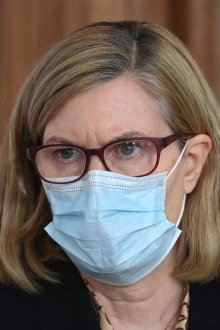
NSW Chief Health Officer Dr Kerry Chant has urged people to stop visiting other households. Nick Moir
One month into the great Sydney coronavirus lockdown the number of daily infections is stubbornly consistent.
On Monday, 76 new COVID-19-carriers were reported circulating in society, up from 62, 71, 70, 70 and 60 in the previous five days.
In Victoria, the same figures were, in reverse chronological order: 0, 2, 3, 2, 6, 4.
Why is the NSW lockdown, at an estimated cost of $1 billion a week, spinning its wheels like a car on blocks?
The answer is: rulebreakers.
Advertisement
Too many Sydneysiders, particularly from working-class suburbs in south-west Sydney, are disobeying a ban on visiting relatives.
“We are seeing that transmissions at the moment are being driven by two factors,” chief health officer Kerry Chant said on Monday, after delivering the unhappy news that four weeks of severe limitations on basic freedoms haven’t tamed the delta variant. “One is ongoing contact between households.”

RELATED
The politicisation of pandemic punditry
“I think sometimes people define what they see as their household as a bit broader,” she said. “They see their aunts, uncles, the next-door neighbour family as almost as safe.”
Visits verboten
The rules are strict. Visiting another household is only allowed for compassionate reasons, or by individuals responsible for a resident’s care. Family social visits are verboten.
Even after extra movement controls were imposed on south-west Sydney a week ago, including mandatory testing, 70 per cent of infections reported Monday were from the area and Western Sydney.
Chant sounded apologetic to call out the selfish behaviour, presumably conscious that it required her to single out a landlocked slice of a city that defines social status by harbour views.
“Can I express my deep understanding of how it is so important; people’s extended family and friends,” she said. “But at this time when we’re in such a crisis, it’s really important that people only stay within the household unit.”
Double inoculations
The other reason the lockdown isn’t succeeding, according to Chant, doesn’t actually cause infections.
Monday’s main message from the NSW government, which took up far more press conference time than family fraternisation, was frustration at the pace of vaccinations.
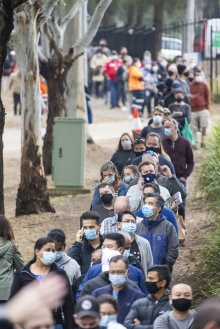
Queues at the NSW Vaccination Centre in Homebush, Sydney, in early July. Getty
If NSW embraced the AstraZeneca vaccine, Chant said, some 350,000 people could be inoculated a week, more than double the 156,760 injections in the state last week, reported by the NSW health department.
Such are the challenges consumer preferences pose to policymakers.
The NSW government is working on a plan to inoculate what it has realised are the truly essentially pandemic workers: truck drivers and other cogs of the logistics chains which keep the economy running.
Because transport and warehouses employ young people, they haven’t been a vaccine priority. A lot of the workforce lives in South-West Sydney too, and moves around the city, spreading a virus their young bodies don’t realise they are carrying.
Targeting them sounds like a sensible plan, except that vaccines don’t become effective for two-to-three weeks, according to Chant.
Slowing COVID-19 transmission next month doesn’t offer much solace to some one million schoolchildren locked out of their playgrounds and class rooms by a virus that doesn’t kill them.
Maybe it is time to put comfort visits to aunty Olive on pause?

Saturday, July 24, 2021
Could DeltaCOVID in South Western NSW have mutated from WuhanCovid hotspots in Willoughby, Ryde, Hurstville-Gladys Berejiklian's failure to ring fence her own electorate in April 2020 may explain Berejiklian's "national emergency"
by Ganesh Sahathevan

NSW Premeir Gladys Berejiklian
In April 2020 NSW Premier Galdys Berejiklian ignored evidence of WuhanCOVID hotspots in her own electorate of Willoughby, and other areas in which WuhanCOVID cases were reported (see story and map below).
Instead of ring fencing those regions like she has done now to a number of LGAs in South Western Sydney, she locked down the entire state, and declared that she had vanquished WuhanCOVID.

Gladys Berejiklian's own data suggests that there may be more than one "Patient Zero"-Is Bondi limo driver who has been cleared of any wrongdoing being scapegoated for NSW Health failures
TO BE READ WITH
Friday, April 10, 2020
Premier Gladys Berejiklian's latest hotspot map seems to have gaps in and around her Willoughby constituency : Have persons in these areas been tested, or is this a case of deliberately ignoring inconvenient evidence
There seems to be a gap in NSW's COVID19/Wuhan Virus mapping. The map below shows hotspots
that NSW Health says should be avoided for fear of community contagion.


The public is entitled to know the extent of testing for COVID 19 in those areas. It does appear as if there has been an attempt to ensure that evidence that inconvenient is never produced.
END
No comments:
Post a Comment