Showing posts sorted by date for query work experience. Sort by relevance Show all posts

Sunday, November 23, 2025

College Of Law Academic Director Lewis Patrick's stewardship of PLT dismissed as "tail wagging the dog" -College students cannot be expected to have confidence in his oversight of their PLT, past students entitled to a full refund of fees

 by Ganesh Sahathevan on Liknedin 

          
         Lewis Patrick
         Chief Academic Officer and Deputy CEO at College of Law


These are not words that can be taken lightly for they are the words of the NSW Legal Profession Admission Board, which is chaired by the Chief Justice Of NSW, Andrew Bell:

As PLT should be a very practical program, it is not necessary that it be taught as a formal AQF accredited qualification – and certainly not to the standard of being a graduate diploma. It is this current requirement which is dictating the length and cost of current PLT offerings – this is a case of the “tail wagging the dog”.
https://lnkd.in/gcx6i_B5


Readers will recall that Patrick defended his stewardship of the PLT,and the PLT itself , by asserting that " the College is not assessing the quality of (the student's) work experience, but rather the quality of (the student's) reflections on that experience.


Patrick said so in an email to this wroter in 2019. Given Andrew Bell's codemntaion of the PLT College students cannot be expected to have confidence in  Partick's  oversight of their PLT, and past students are  entitled to a full refund of fees . They cannot be expected to bear the burden of having to their names a discredited qualification , best described as a dog with fleas. 


TO BE READ WITH 


Thursday, August 7, 2025

College Of Law Academic Director Lewis Patrick remains in office, despite his PLT being condemned by CJ NSW Andrew Bell

 by Ganesh Sahathevan 


College Of Law Academic Director Lewis Patrick remains in office, despite his PLT being condemned by CJ NSW Andrew Bell.As Academic Director reponsible for the PLT for some 20 years he cannot escape laibility for this debacle, which affects College Of Law PLT graduates, and the taxpayers.

To Be Read With 


Thursday, March 27, 2025

Neville Carter v CJ NSW Andrew Bell descends into farce,students and the profession pay the price

 by Ganesh Sahathevan 


The College of Law Australia 's PLT students commenced the compulsory PLT course on 3 March 2025, just three weeks after the Chairman of the NSW LPAB and Chief Justice Of NSW, Andrew Bell, declared the College 's PLT overpriced and in need of reform of its course content. PLT graduates will ultimately seek admission to practise before Andrew Bell. As chairman of the NSW LPAB he is responsible for accrediting and supervising the College's PLT.

The College responded defiantly, its response reported by the AFR under the headline:
College of Law stares down disquiet about high fees and cheating

The CEO Neville Carter had in fact issued an "Update", where he attempted to dispute his Chief Justice's concerns, and which excluded major concerns in Australia and overseas about his and the College's conduct.

Meanwhile, it does not appear as if students are being advised of the Chief Justice's concerns so that they can withdraw, and be refunded their fees, and so that they can enrol with other PLT course providers..

END


Friday, November 7, 2025

Cheif Justice NSW Andrew Bell has declared the College Of Law PLT not fit for purpose- Students, graduates entitled to a refund of fees from the College,and the senior managers responsible for promoting an obviously flawed course

 by Ganesh Sahathevan 


In the words of the NSW Legal Profession Admission Board: 
PLT was designed as a bridge between completion of a law degree and entering legal practice, originally to replace articles. PLT is no longer fit for purpose.
https://lnkd.in/gcx6i_B5


It is good that the NSW LPAB has finally determined that which has been obvious for a very long time.

 Students, graduates entitled to a refund of fees from the College,and the senior managers responsible for promoting an obviously flawed course.


TO BE READ WITH 


TO BE READ WITH 


Saturday, February 8, 2025

Will College Of Law PLT standards continue to be determined by novelist Adrian Deans, and will PLT work experience continue to be judged not by the quality of the work experience, but by the quality of the reflection of the work experience , as described by Lewis Patrick, Chief Academic Director College Of Law

 by Ganesh Sahathevan 

The public questioning of a College Of Law PLT by Chief Justice NSW Andrew Bell demands that these issues concerning the College Of Law be investigated. They have clearly affected the quality of training. 

                     
Mr Adrian Deans
The College's PLT work experience component is overseen by Adrian Dean, a novelist who does not appear to have much exposure to legal practise. 

This writer has had the experience of submitting a work experience journal to Deans, while enrolled as a PLT student at the College. The conclusion of this writer's work experience recorded in the journal was that the College taught little if anything that was applicable in actual legal practise. 


Deans objected to that submission, and requested it be changed. He was unable to defend the relevance of the College's PLT course, except to say that this writer had a "problem" with the course he oversaw. The College's academic head, Lewis Patrick attempted to justify his and Deans' position by stating that PLT students' work experience journals were judged on the quality of the reflection of the experience, and not the quality of the work experience itself.

The above occurred in 2018, when the College's conduct was overseen by the then Chief Justice OF NSW, Tom Bathurst. The above matters were brought the Bathurst's attention, and he did nothing. 

TO BE READ WITH 


by Ganesh Sahathevan


Mr Lewis Patrick 


Lewis Patrick ,  Chief Academic Officer and Deputy CEO at College of Law (COL) , has also resigned as a director of COL's UK venture, the College Of Legal Practise Ltd (COLP) . He joins Nick Savage, COLP's high profile CEO, whose resignation was reported on this blog yesterday.

The reasons for now two high profile departures are unknown; the College and in particular its CEO Neville Carter operate under a code of secrecy and have refused to answer queries about their operations. 

However, its foreign misadventures, especially in Malaysia, are now a matter of public record. Despite these public revelations the College has refused to clarify matters; CEO Carter has in fact gone so far as to portray the Malaysian experience as a plus in promoting the College's expansion into the UK. 
A similar venture in Singapore also seems to have run into problems. 

It is left to be seen how the UK market reacts to the College's uniquely Antipodean methods of instruction in legal training. For example, in his capacity as Academic Director  Patrick once famously declared that in assessing the work experience component of the Practical Legal Training (PLT) course that the College Of Law conducts in Australia " the College is not assessing the quality of (the student's) work experience, but rather the quality of (the student's) reflections on that experience

In fact, the College's Director in charge of the PLT's work experience component is one Adrian Deans, who in the past  decade has become better known as a novelist. 


Wednesday, June 11, 2025

Taxpayers still funding The College Of Law Australia's discredited PLT-Access to FEE HELP financing enabled by Chief Justice Andrew Bell's refusal to withdraw accreditation of what he condemned

 by Ganesh Sahathevan 


Taxpayers are still funding The College Of Law Australia's discredited PLT, despite the Chief Justice Of NSW Andrew Bell publicly condemning the course. Bell is also Chairman of the NSW Legal Profession Admission Board  who together with  TEQSA oversee standards at the College and accredit its courses including the PLT.


Despite Bell's public condemnation , Bell's NSW LPAB and TEQSA are refusing to withdraw  their recognition of the College's PLT. The College can as a result keep drawing on tax payer funded FEE HELP to finance its PLT programme. FEE HELP is not limited to costs, so the College can continue to build the surpluses that  scandalised Chief Justice Bell. 


TO BE READ WITH 


Saturday, April 12, 2025

Recovery of tax payer funded FEE HELP from the College Of Law Australia can begin with the Commonwealth clawing back all funding provided the College Of Law for its now worthless PLT,and then cancelling PLT course debt

 by Ganesh Sahathevan 


The College Of Law Australia's reliance on tax payer funded FEE HELP to finance its PLT course  has been shown to be a wasteful use of limited Commonwealth resources and now that Andrew Bell, the Chief Justice NSW has condemn the College Of Law PLT  (see story below)  it would be unfair  that those who have undertaken the PLT bear any FEE HELP debt associated with that PLT.


Given the Chief Justice's comments the Commonwealth ought to claw back all FEE HELP funding provided the College for its PLT and having done so, cancel the  FEE HELP debt of students who have incurred that debt as a result of having to fund the PLT.  The Chief Justice himself has declared the College Of Law PLT overpriced so students did not really have a choice but to suffer the  debt.


Saturday, February 15, 2025

The Chief Justice NSW Andrew Bell's public condemnation of the College Of Law PLT provides an avenue for PLT students to seek a refund -PLT course and certificate are worthless without the Chief Justice's imprimatur

 by Ganesh Sahathevan 

                         Andrew Bell has been described as ‘one of the most brilliant in a generation’


The College of Law Australia's  Practical Legal Training (PLT) course  has been condemned  by the  Chief Justice NSW Andrew Bell, for offering a PLT course that is not worth the money. Bell has now embarked on a campaign to reform the PLT. 


Bell is not only Chief Justice but also chairman of he MSW Legal Profession Admission Board that accredits  the College as a PLT provider so it is not surprising that Bell's outburst has caused others to offer their own frank assessment of the College's PLT.


Senior practitioners and recent graduates from the 15-week practical legal training course, which requires only five days of in-person attendance and is taught mostly online, criticised its lack of rigour and utility.

They acknowledged a normalisation of cheating by sharing past answers to recycled exam questions and deploying ChatGPT to generate responses.


One junior lawyer, who completed the course last year and now works in the public sector, said prior fees of up to $12,000 were “transparently extortionate, and everyone knows that’s going in. It’s a necessary prerequisite for admission, and students know they won’t gain anything from it”.


“I didn’t feel like I was getting value for money once. Coming from university where academic rigour was held in high regard, to be paying for mundane and reductive online tasks felt like a slap in the face. In order to justify that price, the standard should be a lot higher,” said the lawyer, who asked for anonymity to speak more freely. 

Another junior lawyer, who paid for the course themselves and now works at a community legal centre, said staff did little to combat students’ dim view of the course.

“There’s kind of this unspoken vibe between teachers and students that it’s all pretty bullshit,” they said.

“Written assessments follow the same formula for every subject … but no one puts any effort into them. People either copy someone else’s [answers] or use ChatGPT.

“You can upload the course documents to ChatGPT and ask it to write a letter of advice. I did that and passed everything.”

In light of the above PLT graduates have now a certificate that cannot be said to add anything to their professional standing and if anything embarrasses them. It follows that PLT graduates and students are entitled to recovery of their fees.The College should in fact be providing past and current students with proposals for refund of fees paid for services that were obviously not of the standard promised. Failure to do so, very soon, can be remedied by a class action. 

Complaints about the College's PLT are not new, but the College and its senior managers have always enjoyed the protection of their Chief Justice, which has allowed them to act with impunity.

TO BE READ WITH 


Government funding for the College Of Law PLT where students are assessed on the quality of their reflection on their work experience , not the quality of their work experience

 by Ganesh Sahathevan 

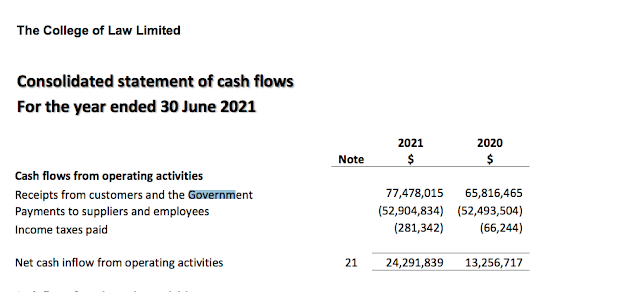
The above has been extracted from the latest College Of Law Ltd's annual report. The substantial government funding is provided via the Commonwealth's FEE HELP facility. 

The Practical Legal Training (PLT)  which the College runs, and which is a prerequisite for admission to practise  in NSW, has the imprimatur  of the Chief Justice NSW, Tom Bathurst, in his capacity as Chairman of the the NSW Legal Profession Admission Board. 

College Academic Director Lewis Patrick has said that in assessing the work experience component of the PLT  " the College is not assessing the quality of (the student's) work experience, but rather the quality of (the student's) reflections on that experience.


The College's PLT course is now mostly on-line, and there are problems with delivery and infrastructure. Its FEE HELP cashflow is being utilised to finance its expansion overseas.


TO BE READ WITH 


by Ganesh Sahathevan


bar council
Very many questions remain unanswered with regards the College Of Law's joint venture with Malaysia's Bar Council.


UK's The Lawyer reported recently that the College Of Law Sydney has decided to break into the UK market, to"battle BPP and ULaw for super-exam supremacy".


Quoting College CEO Neville Carter The Lawyer reported:
“The hallmark of the Australian model is delivery of learning directly into the workplace within a very flexible framework of work placement. The model drives access to the legal services market and fuels the growth of employment opportunities. We believe that the reforms in England and Wales provide an opportunity for us to share what we have learnt in Australia and across Asia and assist in shaping new models and pathways in England and Wales.”


Carter has yet to explain his exaggerated claims of having reformed Malaysian legal practise in the mid 80s; in fact the College's latest venture into Malaysia seems to have ended in failure, again leaving many unanswered questions.
The College has refused to explain why its website dedicated to its "LLM" in Malaysia no loner works, nor has it been replaced with anything similar.

As previously reported, the College seems to have a tendency to invest its mainly government funded revenue in vanity projects in  exotic locations at the expense of its core business of providing the Professional Legal Training course that must be completed by anyone seeking admission to practise in NSW

Complaints against the College are ignored by its regulator, the NSW Legal Profession Admission Board, which is chaired by the Chief Justice of NSW,who considers it the height of bad behaviour to question the relevance and  quality of the College's teaching standards, despite students here having to normally take on a debt of about AUD 10,000 to pay for about 3 months worth of on-line learning, most of which is self taught with minimal input from instructors.
END 


Saturday, February 15, 2025

The Chief Justice NSW Andrew Bell's public condemnation of the College Of Law PLT provides an avenue for PLT students to seek a refund -PLT course and certificate are worthless without the Chief Justice's imprimatur

 by Ganesh Sahathevan 

                         Andrew Bell has been described as ‘one of the most brilliant in a generation’


The College of Law Australia's  Practical Legal Training (PLT) course  has been condemned  by the  Chief Justice NSW Andrew Bell, for offering a PLT course that is not worth the money. Bell has now embarked on a campaign to reform the PLT. 


Bell is not only Chief Justice but also chairman of he MSW Legal Profession Admission Board that accredits  the College as a PLT provider so it is not surprising that Bell's outburst has caused others to offer their own frank assessment of the College's PLT.


Senior practitioners and recent graduates from the 15-week practical legal training course, which requires only five days of in-person attendance and is taught mostly online, criticised its lack of rigour and utility.

They acknowledged a normalisation of cheating by sharing past answers to recycled exam questions and deploying ChatGPT to generate responses.


One junior lawyer, who completed the course last year and now works in the public sector, said prior fees of up to $12,000 were “transparently extortionate, and everyone knows that’s going in. It’s a necessary prerequisite for admission, and students know they won’t gain anything from it”.


“I didn’t feel like I was getting value for money once. Coming from university where academic rigour was held in high regard, to be paying for mundane and reductive online tasks felt like a slap in the face. In order to justify that price, the standard should be a lot higher,” said the lawyer, who asked for anonymity to speak more freely. 

Another junior lawyer, who paid for the course themselves and now works at a community legal centre, said staff did little to combat students’ dim view of the course.

“There’s kind of this unspoken vibe between teachers and students that it’s all pretty bullshit,” they said.

“Written assessments follow the same formula for every subject … but no one puts any effort into them. People either copy someone else’s [answers] or use ChatGPT.

“You can upload the course documents to ChatGPT and ask it to write a letter of advice. I did that and passed everything.”

In light of the above PLT graduates have now a certificate that cannot be said to add anything to their professional standing and if anything embarrasses them. It follows that PLT graduates and students are entitled to recovery of their fees.The College should in fact be providing past and current students with proposals for refund of fees paid for services that were obviously not of the standard promised. Failure to do so, very soon, can be remedied by a class action. 

Complaints about the College's PLT are not new, but the College and its senior managers have always enjoyed the protection of their Chief Justice, which has allowed them to act with impunity.

TO BE READ WITH 


Government funding for the College Of Law PLT where students are assessed on the quality of their reflection on their work experience , not the quality of their work experience

 by Ganesh Sahathevan 

The above has been extracted from the latest College Of Law Ltd's annual report. The substantial government funding is provided via the Commonwealth's FEE HELP facility. 

The Practical Legal Training (PLT)  which the College runs, and which is a prerequisite for admission to practise  in NSW, has the imprimatur  of the Chief Justice NSW, Tom Bathurst, in his capacity as Chairman of the the NSW Legal Profession Admission Board. 

College Academic Director Lewis Patrick has said that in assessing the work experience component of the PLT  " the College is not assessing the quality of (the student's) work experience, but rather the quality of (the student's) reflections on that experience.


The College's PLT course is now mostly on-line, and there are problems with delivery and infrastructure. Its FEE HELP cashflow is being utilised to finance its expansion overseas.


TO BE READ WITH 


by Ganesh Sahathevan


bar council
Very many questions remain unanswered with regards the College Of Law's joint venture with Malaysia's Bar Council.


UK's The Lawyer reported recently that the College Of Law Sydney has decided to break into the UK market, to"battle BPP and ULaw for super-exam supremacy".


Quoting College CEO Neville Carter The Lawyer reported:
“The hallmark of the Australian model is delivery of learning directly into the workplace within a very flexible framework of work placement. The model drives access to the legal services market and fuels the growth of employment opportunities. We believe that the reforms in England and Wales provide an opportunity for us to share what we have learnt in Australia and across Asia and assist in shaping new models and pathways in England and Wales.”


Carter has yet to explain his exaggerated claims of having reformed Malaysian legal practise in the mid 80s; in fact the College's latest venture into Malaysia seems to have ended in failure, again leaving many unanswered questions.
The College has refused to explain why its website dedicated to its "LLM" in Malaysia no loner works, nor has it been replaced with anything similar.

As previously reported, the College seems to have a tendency to invest its mainly government funded revenue in vanity projects in  exotic locations at the expense of its core business of providing the Professional Legal Training course that must be completed by anyone seeking admission to practise in NSW

Complaints against the College are ignored by its regulator, the NSW Legal Profession Admission Board, which is chaired by the Chief Justice of NSW,who considers it the height of bad behaviour to question the relevance and  quality of the College's teaching standards, despite students here having to normally take on a debt of about AUD 10,000 to pay for about 3 months worth of on-line learning, most of which is self taught with minimal input from instructors.
END 


Monday, May 27, 2019

TOP Education Institute's Bachelor of Laws : Political donations,HK Stock Exchange IPO seem to have left regulators confounded, speechless


by Ganesh Sahathevan


Prime Malcolm Turnbull pictured with Top Education's Minshen Zhu.


In 2015 the NSW Legal Profession Admission Board granted a private company the right 
to issue law degrees that would be recognized for admission to practice law in NSW, 
and the rest of Australia.


The then private company has since been listed on the Hong Kong Stock Exchange 
and is known as Top Education Group Ltd (HKG:1752) .It operates the "Sydney City School of Law", 
which has greater semblance to a tutorial college than to the public universities that 
one normally associates with Australian law degrees.


The NSW LAPB's decision took even the Australian Law Students Association by surprise,as 
Lawyers Weekly reported:
New law school may leave grads stranded - Lawyers Weekly


The NSW LPAB is headed by a chairman,who is usually the Chief Justice Of NSW.
The current Chief Justice is Tom Bathurst,who was one of Australia's leading commercial 
QCs before his elevation.


TOP Institute is understandably proud of its achievement, which is advertised on its website:


Top Education Institute received accreditations from TEQSA and the NSW Legal Profession 
Admission Board (LPAB) to offer a course of studies leading to the award of the 
Bachelor of Laws Degree (LLB)


Top Education Institute received accreditations from TEQSA and the NSW Legal Profession 
Admission Board (LPAB) to offer a course of studies leading to the award of the Bachelor of 
Laws Degree (LLB).TOP will commence delivery of the LLB program from 
Semester 2, 2015 for domestic students.


In 2018 Top went for an IPO in Hong Kong.It is listed on the HK Stock Exchange 
and the LPAB and TEQSA accreditation was an important selling point.The listing was a success, 
for the promoters, as one can see from the volumes traded and share price at and since listing:


Top Education Group Ltd
HKG: 1752

TOP EDUCATION (01752) - Technical analysis WMA 
SMA EMA Bollinger SAR RSI


The promoters are led by Professor Dr Minsheng Zhu, better know for his philanthropy, especially towards members of the Liberal and Labor parties.The chairmen of the LPAB and TEQSA have been queried about all of the above; these are not issues students would have to confront from ordinary public universities that award law degrees. At the time of writing , neither has responded.
END  


A Top Education? Dastyari’s Donations Troubles Expose The College With Impeccable Connections

By Wendy Bacon & Ben Eltham on September 2, 2016Education

A top education?

Sam Dastyari’s donations trouble exposes the private college with impeccable connections.
Labor Senator Sam Dastyari has found himself under considerable scrutiny this week over a donation he received from Sydney’s Top Education Institute.


There is no doubt that Sam Dastyari is close to the Top Education Institute – otherwise he could scarcely have called on them to pay his parliamentary travel bill when he exceeded its cap. Close scrutiny has now also revealed that his disclosures on interstate travel have been sloppy, to say the least.


But Dastyari is not the only one to have links to Top Education. The private college is well-known in the corridors of power. Top Education’s director Minshen Zhu is one of the best-connected foreign donors in the country.


Labor Senator Sam Dastyari.
The Top Education Institute is headquartered in the Biotechnology Building of inner Sydney’s Australian Technology Park. It was the first Australian college to be on the Chinese government’s approved list of tertiary institutions. Top Education has achieved the prestigious TEQSA certification to offer Bachelors’ degrees. It is the only non-university institute to offer Australian-accredited law degrees at undergraduate level. This course was originally only approved with conditions in 2013, but was fully accredited without conditions in 2015.
Top Education’s chairperson Minshen Zhu is reported to have close links with the Chinese government, though exactly how close is difficult to ascertain. An ANU graduate, Dr Zhu was a board member of the Confucius Institute of the University of Sydney. He has been a delegate to the Chinese People’s Political Consultative Conference, a consultative body that implies political influence. In 2012, former foreign minister Bob Carr also appointed him to a Chinese Ministerial Consultative Committee.
Criticism of Dastyari, particularly from Liberal Party senators such as Cory Bernardi and George Brandis, has focussed on Top Education’s links with the Chinese government. This is ironic. The public record shows that the Liberal Party also seems to enjoy close connections with Dr Zhu and the TopEducation Institute.
Dr Zhu has been remarkably adept at convincing Australian politicians to help promote and market his institution. Indeed his college has received extraordinary attention from the most senior members of the LNP government.
Former Prime Minister Tony Abbott, pictured with Minshen Zhu.
As prime ministers, both Malcolm Turnbull and before him Tony Abbott found time to attend TopEducation functions. Fairfax yesterday reported that he also met with Attorney-General George Brandis in April this year, and with Treasurer Scott Morrison in November 2015.
The payment of Senator Dastyari’s travel bill has caused him considerable embarrassment. But Dastyari’s $1,670 travel invoice is just a small indication of Top Education’s political largesse. TopEducation has donated handsomely to both major parties in recent years. While Top Education initially favoured the ALP in donations, since the Liberal Party came to power in 2013, Top Education’s donations have shifted to the federal and New South Wales branches of the Liberals.
Australian Electoral Commission registries indicate that the Australian Labor Party has received at least $186,000 from Top Education since 2010. Between 2014 and 2015, Top Education has donated $44,275 to the Liberal national and New South Wales branches. Unusually, the Top Education Institute itself did not disclose any of its donations to the ALP to the AEC. They were disclosed by the ALP.
Dr Zhu and Top Education have also built plenty of face-to-face connections with top Liberal politicians. He is well-known in the party rooms of Parliament. Simple internet searches can easily find photos ofTop Education’s supremo with Malcolm Turnbull, George Brandis and Julia Gillard.
There is also video footage and Facebook photos of Alex Hawke (now the Assistant Minister for Immigration and Border Security) speaking at the Top Education Institute on July 27 2015. Hawke was there on behalf of Tony Abbott and Christopher Pyne, then the education minister. He even read out a special message from the Prime Minister. Such favours have been frugally bestowed on Australian public universities, who were at that stage engaged in fractious negotiations with Pyne over the govenrment’s policy of university fee deregulation. 
Abbott and Pyne were already well-acquainted with the Top Education Institute. They met with the Institute’s senior management in September 2013, just a fortnight after the Abbott government was elected. On Top Education’s website, you can see a photo with Abbott prominently featured. He is pictured holding a brochure for the Institute’s new law school. The close relationship with the government has endured after Abbott’s demise as prime minister. On November 7 2015, Turnbull was photographed holding a course brochure at a dinner with Dr Zhu.
Yesterday, Attorney General George Brandis was keen to distinguish the payment of personal debt from political donations. “Indeed, many of us have met Mr Minshen Zhu and had dealings with the TopEducation Institute but it appears only Senator Sam Dastyari has accepted money from him in settlement of a personal debt,” he told the Senate. Ordinary voters may question this distinction.

Dr Zhu’s big donations at ALP functions

The ALP has been Top Education’s most favoured donation recipient, with at least $186,000 donated to state and federal branches of the Labor Party since 2010. New Matilda attempted to contact ALP Federal Secretary George Wright about the ALP donations but ALP head office said that he was away and not available for comment. New Matilda understands that multiple donations from Top Education Institute are classified as ‘other receipts’ because they were paid at functions and events, rather than as financial gifts without any benefit in return.
The practice throws a spotlight on the increasing popularity of these ‘other receipts” as a category for donations disclosures. As Crikey’s Bernard Keane argued yesterday, “‘Other receipt’ is especially useful because any payment of any kind other than a donation — such as a tax refund, bank interest or a legitimate asset sale — gets lumped into that category, further reducing the clarity of disclosure.”

A donations spree in a time of higher education deregulation

The policy context for Top Education’s donations spree is instructive. Under a policy begun by the Gillard government and continued under the Coalition governments of Tony Abbott and Malcolm Turnbull, tertiary education in Australia has been opened up to the private sector in unprecedented ways.
As a result of these reforms, private education providers such as vocational colleges and institutes are now able to access federal government funding via the FEE-HELP system. This system plays a crucial role in Australian higher education, enabling students to study for expensive tertiary qualifications without paying anything upfront, by taking a loan out through the federal government. Without access to FEE-HELP, private colleges would find it much more difficult to sign up large numbers of domestic students. 
Students at the Top Education Institute can access FEE-HELP.
As New Matilda has chronicled, the expansion of FEE-HELP to private colleges in the vocational sector has been a billion-dollar disaster for Australian education. Notorious swindlers like the Phoenix Instituteand former stock market high-flyers Vocation moved into the sector, vacuumed up hundreds of millions of dollars in government education loans, and then collapsed.
The Top Education Institute is not without its own scandals. In May this year it was reported that TEI was offering internships at prestigious accounting firm PricewaterhouseCoopers. For a cool $2,800, prospective interns could “work closely with PwC partners”, according to an advertisement on social network WeChat. In response, PwC and Top Education then scrambled to explain the advertisement as a misunderstanding; apparently the positions were in fact only a two week ‘development’ course fee.
The arrangement between Top Education and PwC got murkier. In June this year PwC Australia acquired a 15 per cent stake in TOP Education. PwC and Top openly spruiked its investment inTop Education as an opportunity to get involved in the lucrative export education trade.
According to this article on Top Education’s website:
TOP Education’s Chair of Council and former Vice-Chancellor of La Trobe University, Emeritus Professor Brian Stoddart, said that TOP was delighted to align with PwC.
“PwC recognises the value of investment in education export services and of the services already provided by TOP as a leading private innovator in the sector,” he said.
New Matilda is not suggesting Dr Zhu or Top Education have done anything improper. However the generous donations on the public record highlight the assiduous efforts Dr Zhu has made to court major party politicians. 
Examining Top Education’s lobbying efforts suggests that the real play here is probably not Chinese soft power or political influence. In fact, the real value of Top Education’s generosity may be about securing a foothold position in Australia’s increasingly-privatised higher education market. The advantages for a private college looking to cash in on a boom in overseas students looking to study at private universities are manifest.
END