Wednesday, November 16, 2022

Albanese said nothing about Xi's intrusion further into the Luconia Shoals in the South China Sea and ever closer to Australia and Australian oil supplies - Xi now further emboldened ,while Albanese continues to seek cooperation on climate change

by Ganesh Sahathevan


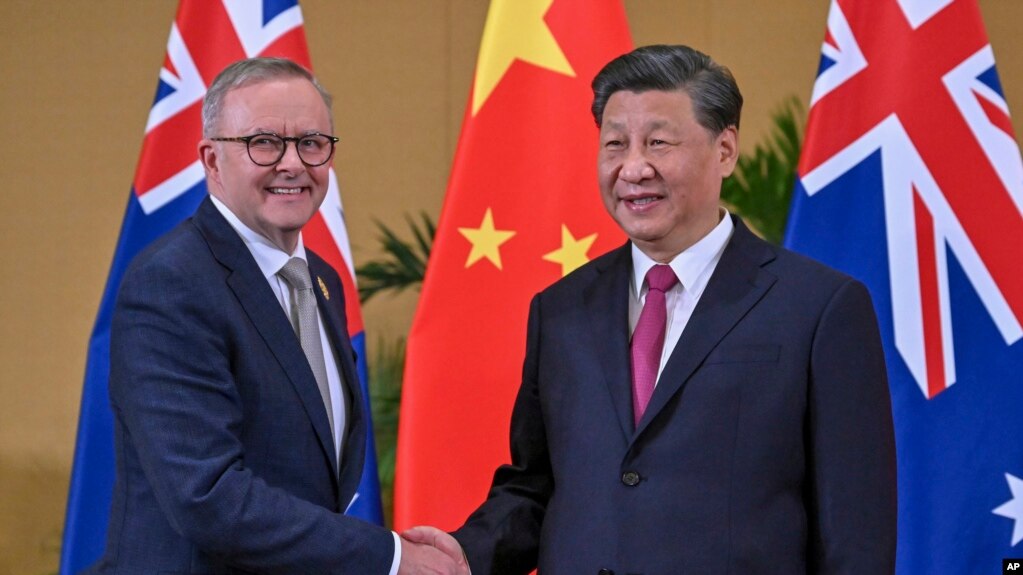
Australian Prime Minister Anthony Albanese, left, meets Chinese President Xi Jinping on the sidelines of the G-20 summit in Nusa Dua, Bali, Indonesia, Nov. 15, 2022.


VOA reported:

Speaking to reporters after his meeting with China's President Xi, Australia's Prime Minister Albanese said talks had been positive.

“It was a very positive and constructive discussion, and I was pleased that it was held,” Albanese said. “We know that China is Australia’s largest trading partner. They are worth more than Japan, the U.S. and the Republic of Korea together, combined. So, it is an important relationship for Australia.”


However, despite the concern with trade, Albanese seems to have said nothing about China's increasingly agressive intrusion into the Luconia Shoals, in the South China Sea, which brings China ever closer the shipping routes in and out of Singapore that supply Australia's fuel. 

Albanese seemed more concerned about China's cooperation in "tackling climate change", as appears to be the case from this exchange during the press conference after his meeting with Xi: 

JOURNALIST: Prime Minister, should we read anything into the fact that the meeting was 32 minutes long? And did you raise issues of climate change, cybersecurity, foreign interference, and any actions on any of those matters?

PRIME MINISTER: I certainly raised climate change and the need for us to work together in tackling climate change. I referred to the floods that are occurring in New South Wales. That climate change is a global issue, and it requires a global response. And China has an important role to play. On Taiwan, I certainly raised that issue. I put Australia's position, which is support for the status quo, which I put forward in the meeting, and that we didn't wish to see any change to that status quo.


Nothing seems to have been said about China's aggression in the South China Sea, which now goes as far down as the Luconia Shoals:
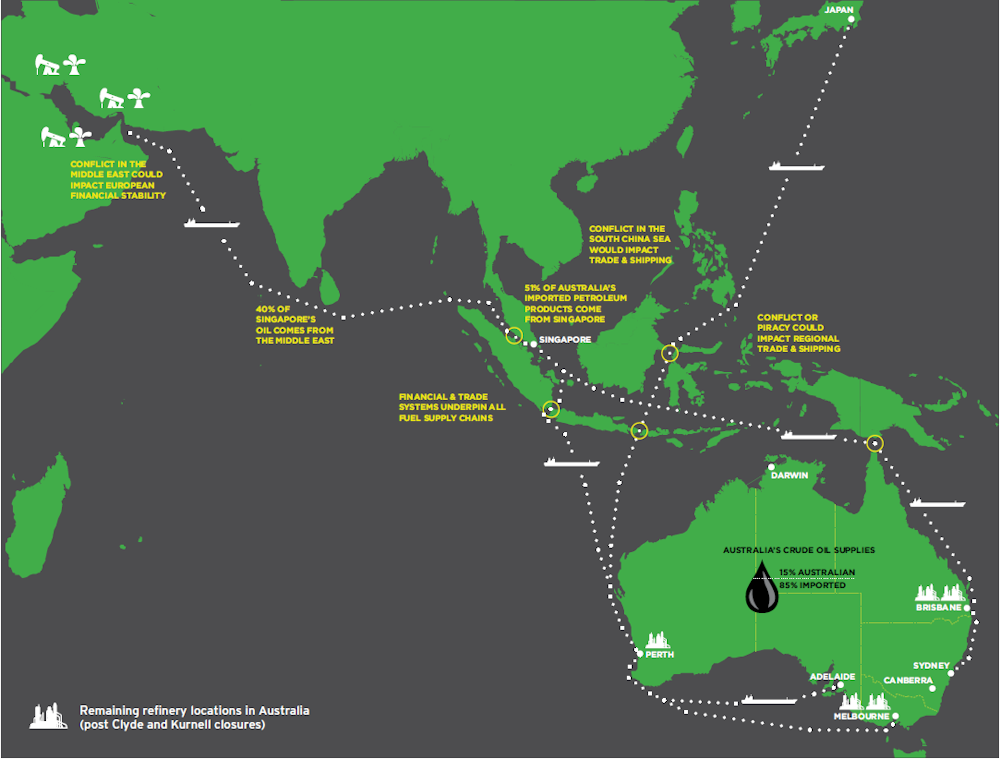
Malaysia has been fighting a losing battle against China in defending its interests around the Shoals, and one would expect that Australia, being a FPDA partner, would do what it can to assist, especially in this instance where Australia's fuel supplies are at risk. As reported, China seems to be manoeuvring itself into a position where it would have effective control over the oil and gas installations, as well as shipping lines.
Xi's meeting with Albanese is likely to embolden Xi in his expansion further down the South China Sea. 

END 

Sunday, November 13, 2022

Siew Ting Tan McKeogh, former NSW LPAB Executive Officer who oversaw the review of Zhu Minshen & Top Group's license to grant LB degree remains a solicitor at the NSW LPAB

 by Ganesh Sahathevan 


The latest extract from the NSW Law Society website.

It is highly intriguing that Ms Tan McKeogh remains e solicitor at the NSW LPAB, despite her role in the Zhu Minshen-Top Group affair. 


Siew Ting Tan McKeogh

Date of NSW Admission09/10/1998
Practising Certificate TypePrincipal of a law practice
Principal Place of PracticeLegal Profession Admission Board
ClassGovernment
AddressLEVEL 4, 37 BLIGH STREET
SYDNEY NSW 2000
Postal AddressGPO BOX 3980
SYDNEY NSW 2001
Firm Phone02 9338 3500
Firm Fax02 9338 3555
RegionCITY OF SYDNEY
Languages other than English spoken in the firm
  • CHINESE
  • MALAY


TO BE READ WITH 


Wednesday, May 27, 2020

Siew Ting Tan McKeogh, NSW LPAB Executive Officer who oversaw the review of Zhu Minshen & Top Group's license to grant LB degrees was replaced soon after renewal of that license: NSW LPAB Chair Tom Bathurst maintains silence despite controversy surrounding Zhu and Top

by Ganesh Sahathevan


As Chief Justice Tom Bathurst has been intent on pursuing a social 
and political agenda. In doing so he has walked into a matter

of national security.In doing so he seems to have neglected his actual duties. 


Siew Ting Tan McKeogh, the NSW LPAB Executive Officer who oversaw  the review  of Zhu Minshen and  Top Group's license to grant LB degrees,  has been replaced after just eight or so months on the job. 

 She was replaced soon after the  review was successfully completed, and signed off on 29 June 2019, just one day before the end of  the financial year. That fortuitous timing allowed Zhu to report in his year end financial reports that his review "went smoothly" .  


The timing also saved the  NSW LPAB from having to report any delay , exception or qualification to that review. The NSW LPAB were able to do so despite the adverse media reports against Zhu and Top Group. 


The Chairman of the NSW LPAB , Chief Justice Tom Bathurst, has maintained his silence despite the controversy surrounding Zhu. 


TO BE READ WITH


Friday, September 27, 2019

Zhu Minshen announces that NSW LPAB review "went smoothly": AG NSW Mark Speakman and officers unconcerned by Clive Hamilton's disclosures of threats, intimidation and defiance of AFP directives ,share price collapse

by Ganesh Sahathevan


The LPAB''s tick of approval does not seem to have reversed the downward trend in share price.Indeed it does look as if the LPAB has ignored all together the fact that Top's market capitalisation has collapsed since listing. Note that Top's shareprice has fallen 14.29% over the past month,compared to 1.13% for the overall market as measured by the Hang Seng Index

In the words of Zhu Minshen, chairman and CEO of his Top Education Group Ltd:


Bachelor of Law Re-accreditation 

The scheduled re-accreditation process of our Bachelor of Laws (‘‘LLB’’) went smoothly. On 27 June 2019, TOP received formal notification from the Legal Profession Admission Board of New South Wales (‘‘LPAB’’) to accredit TOP’s LLB for a further five-year period commencing from the notification date.
(TOP EDUCATION GROUP LTD
ANNOUNCEMENT OF ANNUAL RESULTSFOR THE YEAR ENDED 30 JUNE 2019)


All this despite the revelations of open defiance of an AFP directive, threats and intimidation disclosed in Clive Hamilton's "Silent Invasion",which have been previously reported on this blog:

In his 2018 book "Silent Invasion" Professor Clive Hamilton reports that Top Education Group's Zhu Minshen organised  students , including students from his Top Education Institute to protest  against Tibetans at the  2008 rally , which counted towards the Top students’ assessment.  Zhu’s Top Institution is “perhaps the only accredited degree program in Australia that counts agitating for a foreign power towards its qualifications.”


Hamilton provides details of Zhu's Communist Party China antecedents and his organisation of the 30,000 strong demonstration by Chinese students at the Canberra torch relay, many of them brandishing Chinese flags.

This was clearly an open challenge to the authority , and in public defiance  of, the AFP's directive to Chinese government security that they were not to be involved in the torch relay. As Hamilton puts is "ASIO shat themselves".

Despite this open defiance of the law that they are meant to defend and uphold the Attorney General NSW Mark Speakman and the other senior judicial officers at the LPAB determined that an exception should  be made to allow Zhu to operate the "first and only" law school in Australia that is not part of a university.


END 

See Also 


Law Council Australia 's exception for Zhu Minshen despite Law Council declaring China's justice system "a joke"


No comments:

Post a Comment


Thursday, November 10, 2022

Any payment of "climate compensation" to Pakistan must begin with an assessment of the costs incurred by Pakistan in building its nuclear arsenal, and the consequences for its energy policies -Bhutto's Islamic bomb could not have come cheap

 by Ganesh Sahathevan


The Diplomat reported:

Pakistan’s foreign minister repeated calls for compensation for the unprecedented destruction caused to the country by this summer’s flooding, saying debt relief could be a mechanism for doing so.

Bilawal Bhutto-Zardari told The Associated Press on Wednesday at the U.N. climate summit in Egypt that the world is unequipped to deal with weather-related disasters of this scale and urged countries to find ways to address the issue.


Lost in Bhuto-Zardari's demand are two related and highly pertinent issues.

First, Bhutto-Zardari seems to have forgotten that it was his grandfather Zulfikar Ali Bhutto who set Pakistan on the path to becoming a nuclear power in the 70s, building an arsenal of "Islamic bombs"  regardless of the costs to the Paksitan economy which was then and remains, in effect, a basket case.

The energy sector remains so backward that  approximately 68% of Pakistan’s population depends on firewood as the main source of energy in households

In the words of the World Bank's Rahat Jabeen: 

Every year, Pakistan loses almost 27,000 hectares of natural forest area.

Based on this, Pakistan is in a state of ‘Green Emergency’.

This state of emergency has negatively impacted the rural population that relies on Pakistan’s forests for their livelihoods.

Along with changes in the ecosystem, this dependency has made them extremely vulnerable to the further degradation of forests – a large number of households and workers in this region could lose their vocation, skillset and habitat.

The impact of such extensive deforestation on floods in Pakistan including the most recent seems to have been forgotten by Bhutto-Zardari and others who seek  "climate change" compensation for Pakistan. Bhutto-Zardari also seems incapable, if not unwilling, to say how much more technologically advanced and efficient Pakistan's power generation system might be if the billions spent on building its nuclear arsenal had instead been diverted into its energy infrastructure. That needs to be the starting point of any discussion about compensation.


END 


Monday, November 7, 2022

College Of Law misconduct in Malaysia infected senior lawyers

by Ganesh Sahathevan


As previously reported: 


The Malaysian issues have in fact infected a number of senior Malaysian lawyers. This is one example:


Yang Arif George Varughese remained silent in the face of the College Of Law Sydney's outlandish claims about its decades old reforms to legal practise in Malaysia: Varughese's silence coincided with the College Of Law's promotion of a Malaysian LLM degree that does not have Malaysian Government approval , promoted together with the Bar Council under Varughese's leadership


November 06, 2020


by Ganesh Sahathevan


YA Tuan George Varughese
Pesuruhjaya Kehakiman Mahkamah Tinggi Pulau Pinang

Dilantik sebagai Pesuruhjaya Kehakiman pada 28 November 2019


As reported previously, The College Of Law-Bar Council JV was entered into when YA George Varghese was chairman of the Bar Council. He refused to answer queries about the JV and about the outlandish claims made by the College about its contributions to legal education in Malaysia, going back to the 1980s. The College's claims have been refuted by UiTM, and the Federal Court Registry.

These claims, and claims of having reformed legal practise in Malaysia, have caused offence to senior Malaysian lawyers this writer has spoken to who were already in practise in the 80s. None had heard of the College Of Law despite the ground breaking reforms it claims it had made to Malaysian legal practice at that time.

Even more offensive the College, again with the Bar Council and Varughese's acquiescence, also claims that it produced in 1985-86 the first group of "elite" law graduates from MARA who were admitted to practice in Malaysia. This does come as a bit of surprise to this writer and others like him who know and have known of Malaysian lawyers who graduated from MARA and were admitted to practise in the 1970s. In the latter category is former Chief Justice , YAA Tan Sri Richard Malanjum, who graduated in 1973.


TO BE READ WITH


Judicial CommissionerYA Tuan George Varughese assisted College Of Law Sydney promote Malaysian law masters program that did not have the approval of the Malaysian Qualification Agency ; provided no explanation after College suddenly closed its office in Malaysia, and its Malaysian Masters website vanished

Saturday, November 5, 2022

Singapore Law Society extends training MOU with Australia's College Of Law while Malaysian issues remain unresolved

 by Ganesh Sahathevan 


Angie Zandstra of the College Of Law Ltd posted the above on Linkedin. She seems to have replaced the College's Peter Tritt as its representative in Singapore and Malaysia, but one cannot be sure for Tritt's disappearance from Malaysia in 2019 remains a mystery(see story below).

That the College has shown no desire to enlighten its Singapore, Malaysia, UK and Australian customers as to what took place in Malaysia does not, of course, help resolve anything. 


TO BE READ WITH


Bar Council education ‘JV’ must be clarified

By  , in Scandal on July 19, 2019 . Tagged width:  ,  , 

KUALA LUMPUR, July 19 – The Malaysian Bar Council launched its first education venture, a LLM in Malaysian Legal Practise (LLM), last year in collaboration with the College Of Law Australia.

The LLM does not seem to have the approval of Malaysia’s Legal Professional Qualifying Board (LPQB) but the website for the course, which is hosted in Australia, prominently displays the Bar Council crest.

bar council

The crest has not been used before to promote a course of study, and queries put to Bar Council President Fareed Gafoor about the use of the crest have been acknowledged but remain unanswered.

NMT has however sighted an email from Fareed dated Friday, May 24, 2019 with regards the LLM and the use of the crest where he states:

Dear Rajen,

We can’t remain silent on this.

Abdul Fareed Bin Abdul Gafoor

Sent from my iPad

It is understood that “Rajen” refers to  Rajen Devaraj, Chief Executive Officer of the Bar Council Secretariat in Kuala Lumpur.

The Bar has remained silent for nearly 2 months since.

Key person suddenly retired during extensive query

The College of Law used to be represented in Malaysia by its Director, Peter Tritt. Tritt have been queried extensively about the LLM and about the College’s business in Malaysia but has refused to provide answers. Tritt has been based in Kuala Lumpur since 2017 but announced on Friday that he had “retired” from the College on 30 June 2019.

It is understood that Tritt has forwarded queries sent him to his head office in Sydney and hence it appears that Tritt is under orders from his Chief Executive, Neville Carter, to remain silent.

Questionable advertising claims?

In advertising on the College’s website Carter has claimed that he had established a Professional Legal Training course for Malaysian Law students seeking admission to practise in Malaysia. There seems to be no evidence of such a course, or of any national level training course for the existing Certificate of Legal Practise.

Carter has also claimed to have produced the “inaugural” Handbook in Legal Practise for Malaysia, in the late 80s. A search of the main law libraries in Malaysia directed by the Chief Registrar, Federal Court Malaysia, has not found any such handbook.

He has also claimed to have, during that time to have identified and addressed “gaps” in Malaysian legal practise, but not even those in practice during that period and since have ever heard of him. Nor are senior practitioners aware of  “gaps” that needed that to be addressed by external consultants.

As CEO of the College Carter  has ultimate responsibility for the College’s Malaysian operation headed by Tritt and variously named the “College Of Law Asia Pacific” and the “College Of Law Asia”. A search by NMT has not revealed any entities registered under those names in Malaysia or in Australia, not even a foreign entities registered to conduct business in Malaysia.

Meanwhile the College, in collaboration with the Bar Council continues to sell its LLM and other courses in Malaysia, deriving a fee income from Malaysian courses.

-NMT


Friday, November 4, 2022

Singapore and the China opium trade -Nothing to be ashamed of, it was strictly business ,and led by the Peranakans

 by Ganesh Sahathevan 


Extracted from  James Francis Warren (1995) Capitalism and addiction-the Chinese, revenuefarming, and opium in colonial Singapore and Java, 1800–1910, Bulletin of Concerned AsianScholars, 27:1, 59-72, DOI: 10.1080/14672715.1995.10413075   


In the words of Carl Trocki:


The founding of Singapore was a peripheral result of the India-China opium trade.1 That trade, portrayed in the works of David Edward Owen and Holden Furber, has been updated by Jonathan Spence, among others.2 Its details and history are integral to the history of the Singapore Chinese. For a full century, Singapore was "Opium Central: Southeast Asia." Opium was so common in nineteenth-century Singapore that most writers seem to take it for granted.

The following excerpt  is from the Singapore Government  NLB website:


The (British Colonial)  government earned most of its revenue by franchising the opium trade to wealthy Chinese businessmen. Well-known names in the opium trade include Lau Joon Tek and Cheang Sam Teo, who made up the Lau-Cheang Syndicate, Heng Bun Soon, Tan Seng Poh and Cheang Hong Guan. Cheong Hong Lim and Tan Seng Poh were other well-known names who partnered with Tan Hiok Nee (Tan Yeok Nee) in spirit and opium farming. Opium, or chandu (Malay for cooked opium), was commonly inhaled or smoked. The ash or residue after opium was smoked for the first time was also recovered by shopkeepers and sold at a cheaper rate.

And this from the Government's National Heritage Board website, "Great Peranakans":

Peranakans initially worked for the large British trading companies as intermediaries, since they could speak Chinese dialects, Malay, and also English. They later set up their own companies to supply Chinese workers, grow gambier and other commodities, and run shipping companies. Several wealthy Peranakans purchased the government monopolies of opium, which proved to be extremely profitable.


END 

Monday, October 24, 2022

PM Lee Hsien Loong confronted with another Crooked Bridge dilemma. From the south, out of Australia, Australia's PM Albanese demands that Hsien Loong share his fantasy of a solar power cable connecting Singapore and Australia

 by Ganesh Sahathevan


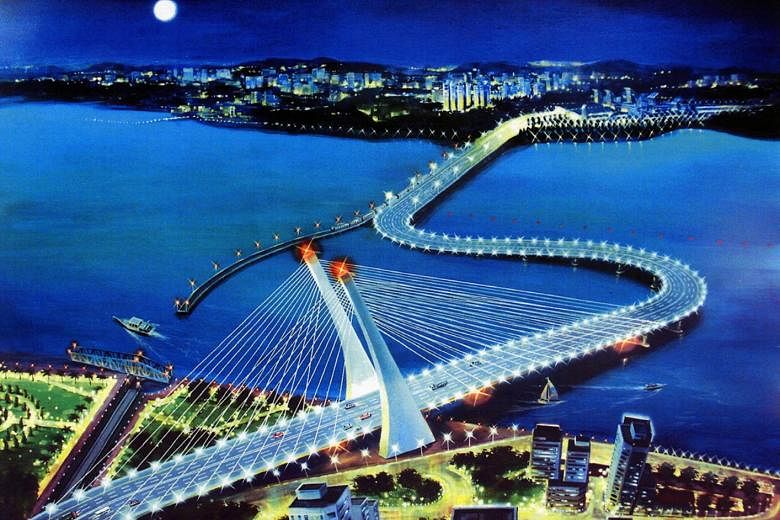
The crooked bridge project was mooted by Malaysian Prime Minister Mahathir Mohamad before he retired as premier in 2003. PHOTO: GERBANG PERDANA


For much of the past decade Singapore has had to endure demands from Malaysia's Mahathir Mohamad that the causeway connecting the two countries be replaced by what has become known as the Crooked Bridge. His resignation as prime minister of Malaysia in 2020 seems to have put that demand to rest but now it seems Singapore and its prime minster Lee Hsien Loong are being tormented by a similar demand, this time from the south,  from Australia's PM Albanese  who  demands that  Hsien Loong share his fantasy of a solar  power cable connecting Singapore and Australia. 

As this writer noted, Albanese seemed to be channeling BJ Habibie, the former Indonesian President (who is supposed to have described Singapore as a little red dot) when he told Hsien Loong at a press conference in Canberra: 

"This island continent of ours is a little bit bigger than the island continent of Singapore...... And hence, a project like Sun Cable, which has the potential to export clean energy to Singapore, is the ultimate win-win. If this project can be made to work - and I believe it can be - you will see the world's largest solar farm, you will see the export of energy across distances, the production of many jobs here in Australia, including manufacturing jobs".

Hsien Loong said nothing in response, and that is to be expected for  Hsien Loong, his government, and the relevant authorities have yet to provide Sun Cable any approvals whatsoever to Sun Cable:

Infrastructure Australia says Sun Cable's Darwin-Singapore solar cable qualifies for taxpayer funding, Singapore says Sun Cable does not have permission to import electricity into Singapore


While Mahathir's insistence on the Crooked Bridge despite a lack of interest from Singapore caused local Malaysian media to investigate the motivation for the project, there has yet to be any serious investigation in Australia into Albanese's fantasy.

END