Sunday, January 15, 2023

"Export Australian sunshine to Singapore" - Sun Cable collapse has consequences for PwC ; investors, Australian Govt, likely to have relied on PwC's statements

 by Ganesh Sahathevan 


    In pWc's words, "export Australian sunshine to Singapore"


Sun Cable's collapse has consequences for PwC  for investors, the Australian Government and others who have lost money on this fantasy  are likely to have relied on PwC's statements when committing resources to the project.  

As mentioned on this blog in 2020:


PwC  has led the fund raising for the Australian project, and one does wonder about their liability for promoting the project:
The Australia Singapore Power Link (ASPL) aims to supply renewable electricity from a 10GW solar farm to both Darwin and Singapore via a high voltage direct current transmission line – a plan first outlined by Beyond Zero Emissions in August, and which quickly attracted the attention of the likes of Cannon-Brookes.
According to a release from pWc, who guided the fund-raising process, the project will also include a massive 22GWh of battery storage located near Tennant Creek in the Northern Territory,  with electricity supply transported by a high voltage direct current transmission network, extending 4,500 km from the project site.


TO BE READ WITH 


Tuesday, July 28, 2020

Angus Taylor & Australian Government grant billionaires Twiggy & Canon-Brookes solar power to Singapore project Major Project Status: Still no word from Singapore if the supply will be accepted,so why is the Australian Govt throwing money at these billionaires at their sun light white elephant?

by Ganesh Sahathevan


Renew Economy and others have reported: 

Minister for industry, science and technology Karen Andrews said on Wednesday that the Australian-ASEAN Power Link (AAPL) for the massive project, planned for the Northern Territory’s Barkly region near Tennant Creek, had been granted Major Project Status.


Federal minister for energy and emissions reduction, Angus Taylor, said the Sun Cable project would maintain Australia’s position as an energy exporting powerhouse.

“Australia has long been a world leader in energy exports,” Minister Taylor said. “As technologies change, we can capitalise on our strengths in renewables to continue to lead the world in energy exports.”


Meanwhile Singapore has had nothing to say about buying this power, and neither have Indonesia or any other ASEAN Country.
TO BE READ WITH

Wednesday, November 20, 2019


Australian billionaires propose to do a Bakun where Olivia Lum failed: Twiggy & Canon-Brookes looking decidedly old school, taking after Ting Pek Khiing,and is PwC going to be answerable to investors in this remake of the mid-90s Bakun Undersea Cable disaster

by Ganesh Sahathevan


Atlassian co-founder Mike Cannon-Brookes' family investment firm, Grok Ventures, will help fund development of a solar-power link between the Northern Territory and Singapore.


First the Sydney Morning Herald  headline, which seems not to have  made any impact in Singapore:

Billionaires invest in 'massive' solar farm to supply power to Singapore


Australian billionaires Mike Cannon-Brookes and Andrew "Twiggy" Forrest have joined a capital raising of "tens of millions of dollars" to build a huge solar farm in Australia to supply electricity to Singapore.

David Griffin, chief executive of Sun Cable, did not disclose the total investment other than to say it was less than $50 million. Mr Cannon-Brookes and his wife, Annie, were "lead investors" with their family firm Grok Ventures, while Mr Forrest tipped in funds from his Squadron Energy company.


The over-subscribed raising marks the start of what could become a $22 billion plan to build the world's largest solar farm with a 10-gigawatt capacity covering 15,000 hectares near Tennant Creek in the NT, and a 22GW-hour storage plant.

The project would aim to supply competitively priced electricity to the Darwin region and to Singapore via a 4500-kilometre high-voltage cable.
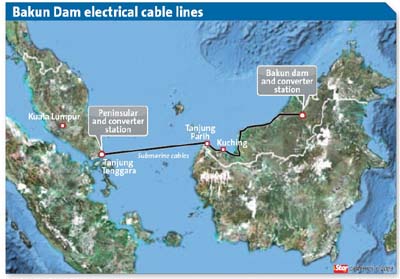


All this brings to mind a slightly less ambitious plan from the mid 90s, which was even easier to fund, and finally died ten years ago despite valiant attempts by less than clean politicians to keep it alive


RM10b bonds to fund cable project


See Also 

Damned Corruption Began With Bakun


AND, Singapore's energy market is a tough one, even for local heroes like Olivia Lum, who has got  badly burnt by an attempt to diversify into energy generation:

In 2017, Hyflux embarked on a divestment exercise of Tuaspring Integrated Water and Power Project - the company's largest asset - "in line with its asset light strategy", but was unable to finalise any binding bids.
It said that "despite strong initial interest in this project", losses from electricity generation, lack of understanding of Singapore power market by potential buyers and delayed regulatory approval led to "a protracted sale process"
PwC  has led the fund raising for the Australian project, and one does wonder about their liability for promoting the project:

The Australia Singapore Power Link (ASPL) aims to supply renewable electricity from a 10GW solar farm to both Darwin and Singapore via a high voltage direct current transmission line – a plan first outlined by Beyond Zero Emissions in August, and which quickly attracted the attention of the likes of Cannon-Brookes.
According to a release from pWc, who guided the fund-raising process, the project will also include a massive 22GWh of battery storage located near Tennant Creek in the Northern Territory,  with electricity supply transported by a high voltage direct current transmission network, extending 4,500 km from the project site.
END 


Saturday, January 14, 2023

Tokoh Wartawan Negara Rejal Arbee lied under oath about his knowledge of Singapore billionaire Peter Lim's business in Malaysia - Recent spotlight on Lim's business in Malaysia calls for an investigation of Rejal's perjury ,and Lim's businesses

 by Ganesh Sahathevan 


      Vincent Tan,and in the inset,Peter Lim


As recently reported on a related blog,   Tong Kooi Ong's pursuit of Murad Khalid raises questions about Murad's business with Singapore billionaire Peter Lim, and raises even more questions for PM & FM Anwar Ibrahim when considering any application from Berjaya and Vincent Tan for a banking, finance or insurance business license or approval.


Additionally, Tong's spotlight (even if it be inadvertent) on Lim's businesses in Malaysia draws attention to Tokoh Wartawan Negara Rejal Arbee's perjury before the Industrial Court, Malaysia , in the matter of Sahathevan v Sun Media, when  he told court that an article in The Sun about Lim's businesses in Malaysia was wholly without basis. Arbee was at the relevant time Managing Editor of Sun Media Group, publisher of The Sun.

Rejal testified under oath with reference to the article that he  published, and not the article submitted which he and his subordinates edited to remove reference to the primary source of the story, Tan Sri Mokzhani Mahathir. 

Tong has resurrected these issues at a time when judicial matters are again prominent.  


TO BE READ WITH 

Thursday, January 7, 2021

In 1998  Sessions Crt judge  Saufee Affandi was specifically assigned to a contempt matter involving Vincent Tan's Sun Media, and managed to place blame on the Sun reporter while excusing Sun Media and its editor Rejal Arbee; Saufee's conduct in '98 adds context to his legal innovation in favour of Sun Media, Singapore billionaire Peter Lim, Vincent Tan ,their business partners , and others in the matter of Ganesh Sahathevan v Sun Media 

 by Ganesh Sahathevan

tokoh 15 (8)            YBhg Datuk Ahmad Rejal Arbee


As reported earlier on this blog, former Industrial Court Chairman Saufee Affandi managed to turn an Industrial Court claim by this writer against Vincent Tan's Sun Media into a defamation matter where he undertook to prosecute the case for Singapore billionaire Peter Lim and his business partners, despite not having any authority to do so, and despite Lim himself never commencing a claim against Sun Media or this writer. 

It has also been reported here how Saufee mismanaged  and in essence attempted to discredit evidence against Bursa companies Gamuda Bhd, Litrak Bhd and the EPF which had financed their privatised LITRAK toll road project, which had been discovered by this writer.


It can now be revealed that Saufee had a prior, and perhaps more questionable involvement with Sun Media in 1998 when he served as a Sessions Court judge. The matter was reported by The SUN (which is published by Sun Media): 

A Sun reporter was fined RM 2,500 today when he admitted defying a court order which prohibited the publication of certain information in the case of a sessions judge who allegedly performed oral sex on a man. Sessions judge Saufee Affendi, who had come from Kuala Lumpur to specially hear the case. 

A conviction under this sub-section carries a maximum fine of RM 5,000 or jail up to three years or both. Arulldas, who paid the fine, was accompanied by Sun Media Group editor-in-chief Ahmad Rejal Arbee and editor Andy Ng.


Why Vincent Tan's Sun Media and its editors Ahmad Rejal Arbee and Andy Ng who actually published the story were not also charged is mystifying. 

Even more mystifying is the fact that Saufee  accepted that the crime of contempt had been proven beyond a reasonable doubt  against a  reporter who had absolutely no power to publish. The contempt, described above involved the publication of facts which were subject to a court order against publication. 


WHETHER WE SEND TROOPS OR CASINOS, OUR ISLANDS FACE THE FALKLANDS FACTOR

 WHETHER WE SEND TROOPS OR CASINOS, OUR ISLANDS FACE THE FALKLANDS FACTOR


By Peter Robinson
1,420 words
10 November 1987
Australian Financial Review
12
English
© 1987 Copyright John Fairfax Holdings Limited. www.afr.com Not
available for re-distribution.

Although it is still as tiny in the totality of Australia's strategic
concerns as a rocky outcrop in the vastness of the Indian Ocean,
Christmas Island is just now beginning to hint at its potential for
trouble.

Suggestions at the weekend that after the phosphate mining operations
are closed down Australia may establish a permanent military presence
on the island indicate the possible dimensions of the policy decisions
which will have to be made.

However remote it may still look, moreover, the real concern which
pervades any consideration of the island's future is the possibility
that it may ultimately become Australia's Falklands - a symbolic,
economically useless piece of territory which for reasons of national
prestige or credibility might actually have to be defended at vast
cost in lives and money.

It may seem incredible, crazy and inconceivable, but the fact is that
the development of policies to deal with such possibilities is what
defence and foreign policy planning is all about.

Equally, it is an undeniable fact that changes in relationships with
Asia and the US demand a broader and more sceptical Australian
assessment of regional threats.

The fact that the assessment is made does not mean that there is any
change in previous attitudes, but merely that the totality of the
national position has been refined.

Australian defence planners have this problem as far as the minuscule
Christmas Island situation is concerned. The country really has three
or four choices - establish a token military presence to maintain the
airstrip there in good working condition, maintain a non-military
government presence of some kind simply to assert Australian
sovereignty (for example, a meteorological facility), abandon the
place altogether, or, as one cartoonist wittily pointed out yesterday,
"send in a casino".

In every rational economic sense, the mined-out island will be of no
significance to Australia or anyone else, yet as a kind of static
aircraft carrier it does have a potential strategic role - more,
perhaps, for a potential aggressor than for Australia itself.

Christmas Island is about 3,000km north of Perth, less than 400km
south of Java and about 1,000km east of Australia's other island
territory in the Indian Ocean, Cocos, or the South Keeling Islands.

Clearly, the island would be important in any confrontation with
Indonesia, but equally clearly it would merely exacerbate problems if
it ever were developed into anything that could be called a "threat".

To that extent, it is surely a "neutral" factor.

Its phosphate deposits have been a vital source of materials for
making superphosphate fertiliser and in 1947, just after World War II,
Australia had asked that sovereignty be transferred to Canberra. But
at that time, the British still firmly saw themselves as a world power
with a deep involvement"east of Suez" and the approach was rebuffed.

However, the following year Australia and New Zealand did acquire the
exclusive right to mine the island's phosphate deposits.

In 1954, the Menzies Government made another approach to the British
for a transfer of sovereignty and in 1958 control was transferred to
Australia.

The British - looking at the island mainly from a Singapore
perspective -clearly regarded it as being of strategic importance and
with good reason -and were not in any hurry to transfer it to
Australia.

First of all the guerilla war in Malaya and subsequently the
confrontation with the Indonesia of President Sukarno gave it a
particular significance.

Papers released in 1985 disclosed that strategic considerations were
also an important factor in Australia's persistence in trying to gain
formal control.

A submission to Cabinet by the then Territories Minister, Paul
Hasluck, and the External Affairs Minister, Richard Casey, proposed
the building of an airstrip and added: "An air-staging post on
Christmas Island would provide a fighter reinforcement route between
Australia and Singapore vastly superior to the long and circuitous
routes through Dutch New Guinea and the Philippines which would
otherwise be necessary."

The same submission stressed the importance of Australia acquiring
control of the island before Singapore gained independence from
Britain.

It is difficult to see any reason then, or any today, why Singapore
should wish to claim sovereignty over the island, but such a claim
would probably be somewhat more valid than the successful claim which
Indonesia made on West Irian on the grounds that it was always
administered by the former colonial power, Holland, as an integral
part of the Netherlands East Indies.

Christmas Island, before Australia took it over, was administered from
Singapore and most of its inhabitants were (and are) from that island
State.

There is, of course, no reason why Australia and Singapore should ever
become embroiled in a dispute over the despoiled hulk of Christmas
Island, unless Australia either in actuality or in a de facto way
simply abandoned it like a piece of space junk. In that case, perhaps
some dispute over sovereignty could arise.

In fact, after it took control of the island, Australia several times
assured Indonesia that it had no intention of building significant
military facilities on the territory.

Given the island's proximity to Indonesia as well as its closeness to
the Timor Trench, which is still regarded as being an oil-prospective
area, sensitivity in Jakarta over what Australia might do with the
island is understandable.

Yet according to a report published in The Times on Sunday last
weekend, Australia is now considering "a military presence" if various
civilian plans to rehabilitate the island fall through. Phosphate
mining is due to be phased out in three or four years and unless other
commercially viable activities are found, the island may be
depopulated.

The main civilian plan to rehabilitate the island is a casino-resort
complex which according to some reports will depend on wealthy Chinese
from Singapore and Malaysia, and on others will service Australians
anxious for an Indian Ocean paradise.

Quite frankly, I find it difficult to believe in these projects. There
is by now no shortage of casinos and the money being pumped into
Australian-based resorts suggests anything on Christmas Island would
have to be exceptional to compete.

The island itself as far as I know is not particularly attractive and
will be even less so by the time the mining is finished, even though
there may be some grotesque attraction in observing the horrible
results of a mining culture.

The alternative of establishing a kind of military base there seems
even more ludicrous to me.

The place had an obvious significance when short-range aircraft were
being ferried frequently to South-East Asia, but this has long since
disappeared -just as the former Cocos strip which served Qantas
flights to South Africa has become irrelevant.

To place any sort of military base on the island (or on Cocos for that
matter) is surely an undesirable military gesture. No matter how small
the"base", it is a military presence. Indeed, the smaller it is, the
less scope there is for negotiating a reduction in size some time in
the future.

Australia has a genuine long-term problem about both Cocos and
Christmas islands. It either indicates that it takes them seriously
and therefore, on one or both of them, puts a decent military presence
or it tries to reduce the level of discussion by putting no military
presence.

The latter decision is theoretically fine - but it makes no provision
for political reality.

If there should ever be any kind of dispute at all with places like
Indonesia or Singapore - or any kind of discussion with the US about
using Australian territory for American bases in the Indian Ocean -
Australia will be very vulnerable if it has already airily decided
that the islands have no military significance.

The idea of "sending in a casino" has already been initiated, although
commonsense suggests that it will depend much on the marketing skills
of the companies involved.

Abandoning the territory is really inconceivable, simply because the
political reaction to any foreign occupation would be insupportable.
This is so whether it is totally unoccupied, occupied by a few
scientists or by a tourist hotel.

Australia should have some minor military presence on the island
because it indicates a determination to remain there. The alternative
is to indicate that we simply don't care - which in political terms
means that sooner or later we will face a Falklands situation.

Document afnr000020011118djba00g1q

Friday, January 13, 2023

Leslie Fong's claim that KPMG, PwC approved of double counting has significant implications for the audit of the valuation of SPH mastheads - KPMG, PwC will have to explain why they failed to qualify the valuation of the mastheads

by Ganesh Sahathevan 


The following is an extract from SPH's 2018 Annual Report, audited by KPMG. With regards the valuation of intangible assets, including mastheads, KPMG said: 


The above is a fairly standard clause, and likely to be found in other SPH annual reports, including those audited by PwC.

In investigating cashflows underlying the valuation of mastheads the  discrepancy between cash receipts and circulation figures would  have become apparent given the double counting. In fact, Leslie Fong says the auditors were aware and approved of the double counting.

The question then, for the auditors, is why they failed to qualify the valuation of the mastheads. 


TO BE READ WITH 


Thursday, January 12, 2023

KPMG and PwC said to have approved of SPH Media's double counting

by Ganesh Sahathevan


The WhatsApp message below appears to be that which is referred to in the Today Online story Explainer: What are circulation and readership figures and why does the SPH Media saga matter?

It includes this startling claim:

This has been industry  practice, endorsed by every external auditor SPH has used, whether KPMG or PriceWaterhouse, and every SPH main board led by the likes of Lim Kim San or Tony Tan. 

KPMG and PwC have much explaining to do.


TO BE READ WITH 


 So it seems like the fraudulent numbers aren’t new, and it’s been a long time practice. The new CEO is considered a crusader (some would call her foolish and naive), and she’s been auditing this and that. It seems she opened up a GIANT can of worms with the figures and now those who know about this open secret are scrambling left, right, sideways, backsides to PRETEND they KNOW NOTHING. 


Those 3 guys were merely just continuing the system and were made eazy convenient scapegoats.

Here are just some of the facts: 

1.  Since more than two decades ago, the Audit Bureau of Circulation has accepted as legitimate:

a) that bulk sale of, say, 1,000 copies of the ST to, for example, a shopping mall for free distribution to its shoppers be counted as 1,000 circulated copies. Even if only half were actually picked up (the leftovers  would be sold as scrap for recycling but never dumped into the sea, as some claimed. I challenge anyone to show me a photo of hundreds or thousands of copies of ST or ZB floating in Kallang River or Changi Beach.

This has been industry  practice, endorsed by every external auditor SPH has used, whether KPMG or PriceWaterhouse, and every SPH main board led by the likes of Lim Kim San or Tony Tan. 

So I would be very careful before making allegations of fraud and collusion.

b) the inclusion under circulation numbers of management copies sent free to advertising agencies as well as advertisers so they could show their principals the ads they paid for.  All above board, sanctioned by ABC. 

2)  If a household pays for a print copy as well as a digital subscription, ABC allows that sale to be counted as two copies. In some other countries, if the digital subscription covers an e-paper or PDF version, the publisher can and often does claim a count of three!  SPH kept it as two. 

So this is legitimate "double counting", not cheating or inflating.

These are just two examples. Newspaper publishing is not a simple business. But here we have those who have not taken the trouble to check and understand jumping in and letting loose ill-informed, possibly slanderous, invectives.

The root of it is a new management telling a half-baked story to explain the sacking of three leftover senior staff who had served the company faithfully for years and years, only to see this spun out of control, resulting in severe damage to its newspapers.. via