Friday, January 13, 2023

Tong Kooi Ong's pursuit of Murad Khalid raises questions about Murad's business with Singapore billionaire Peter Lim, and raises even more questions for PM & FM Anwar Ibrahim when considering any application from Berjaya and Vincent Tan for a banking, finance or insurance business license or approval

 by Ganesh Sahathevan 

      Vincent Tan,and in the inset,Peter Lim

Tong Kooi Ong's pursuit of Murad Khalid resurrects the Ayer Molek scandal, and prevents Anwar Ibrahim from approving Vincent Tan and Berjaya's plans to acquire a financial services business.

That however is not the only complication. S. Jayasankeran revealed, in a 1996 story published in the Far Easter Economic Review , that Murad Khalid had business dealings with Singapore billionaire Peter Lim, who was then known as the Remisier King Of Singapore: 


Murad, now with 42% of Ayer Molek, seeks to sell the shares for M$157 million to balance Rakyat's books. He turns to broker Peter Lim of Kay Hian-James Capel, who, after two unsuccessful attempts at placement, enlists the help of Phileo Allied's Tong. One of Kuala Lumpur's hottest deal makers, Tong agrees to place the shares but splits them into one block of 30% and three small ones of 4% each. (A possible reason for the split: A sale of more than 33% to one party would require a general offer at the same hefty premium to market value at which Phileo was placing the shares.) .....  According to a well-informed source, the 30% block is sold to an Australian-based investor, whom the source declines to name, for M$112 million.


Peter Lim's Kestrel Group of companies had been, in and around 1995 involved in a number of high profile deals transacted on the KSE.  His partners included Vincent Tan's Berjaya Cayman. Those transactions remain unexplained.Answers from all involved ought to be required when Prime Minister and Finance Minister Anwar Ibrahim considers Vincent Tan and Berjaya's application to acquire a business regulated by Bank Negara and the Ministry For Finance.

END 

Reference 

BUSINESS
COMPANIES --- Back to Square One: The tangled tale of Malaysia's Ayer Molek
By S. Jayasankaran in Kuala Lumpur
2082 words
21 September 1995
82
English
(Copyright (c) 1995, Dow Jones & Company, Inc.)

Ayer Molek is a small Malaysian rubber company that owns some plantation land. Its other assets are a listing on the Kuala Lumpur stockmarket and the fact that it has a mere 1.8 million shares in issue. Many Malaysian investors love small, illiquid stocks; they present possibilities for lucrative asset shuffles that boringly big companies can't match.

Even by these standards, however, Ayer Molek has recently generated more than its fair share of excitement.

An acrimonious tug-of-war over Ayer Molek shares has challenged the integrity of Malaysia's justice system, threatened the solvency of a financial-services company, spawned numerous lawsuits and at least two police investigations, and embarrassed the country's central bank.

And yet all this ulcer-inducing unhappiness is now supposed to disappear as a result of an agreement between the two companies on opposite ends of the Ayer Molek share transaction. Under a deal hatched on September 8, financial-services firm Insas (the buyer) and banking and broking group Phileo Allied (the seller) agreed to cancel the share sale at the centre of events. By doing so, they will help rescue a troubled state-owned merchant bank, remove the source of an unseemly public row that has split judges and lawyers, and avert a possible chain of financial defaults.

Bravo? Not quite. The closed-door peace settlement between warring parties showed Malaysian corporate ingenuity at its best -- and worst. The accord and the events preceding it raise numerous questions about the sanctity of contracts and transparency of business dealings in Malaysia at a time when Kuala Lumpur is trying to become a financial centre to rival Hong Kong and Singapore.

"The important thing is that no one will lose," says Tong Kooi Ong, chief executive of Phileo Allied.

A bemused lawyer is less sure. "The judicial crisis was sparked by allegations that litigants in commercial disputes could choose their judges. Now it looks like everything will be forgotten."

The Ayer Molek saga has been far from simple. While many aspects of the affair remain unexplained, the following picture emerges from court and other documents and interviews with many of those principally involved:

In April 1994 state-owned Rakyat Merchant Bankers, now renamed BSN Merchant Bank, goes bankrupt. Four of its senior executives are subsequently charged with lending M$330 million ($132 million) to 110 bogus companies and individuals for the purposes of buying shares in listed companies.

Bank Negara, Malaysia's central bank, institutes a rescue, led by senior adviser Datuk Abdul Murad Khalid. He discovers the scam involved purchases of controlling stakes in three small companies, one of which is Ayer Molek. It appears M$157 million has been paid from Rakyat's accounts for 51% of the rubber company.

Seeking to recover this sum, Murad gains possession of 30% of the shares and traces others to Choo Keng Weng, a middleman. Some negotiation is required to obtain their return. On September 23, 1994, Choo agrees to hand over a 12% Ayer Molek stake to the central bank free of charge; in return, Bank Negara allows him to keep 5.7% of Ayer Molek and promises to withdraw "all complaints, allegations and court actions" against Choo. (Another 3% of Ayer Molek is unaccounted for.)

Murad, now with 42% of Ayer Molek, seeks to sell the shares for M$157 million to balance Rakyat's books. He turns to broker Peter Lim of Kay Hian-James Capel, who, after two unsuccessful attempts at placement, enlists the help of Phileo Allied's Tong. One of Kuala Lumpur's hottest deal makers, Tong agrees to place the shares but splits them into one block of 30% and three small ones of 4% each. (A possible reason for the split: A sale of more than 33% to one party would require a general offer at the same hefty premium to market value at which Phileo was placing the shares.)

According to a well-informed source, the 30% block is sold to an Australian-based investor, whom the source declines to name, for M$112 million.

The three small blocks, meanwhile, are sold to three companies domiciled in the British Virgin Islands. However, the combined 12% is registered under the name of PFA Nominees, a local nominee company.

Subsequently, Insas enters the picture, and agrees to buy the 30% block -- but this time the price is M$157 million, the total sum Bank Negara was seeking. The deal is sealed on September 27, 1994, when M&A Securities, an Insas stockbroking subsidiary, contracts with Phileo to buy the block -- 20% for Insas and 10% for Megapolitan Nominees, a company believed to be linked to Insas boss Datuk Thong Kok Khee. M&A pays Phileo a 10% downpayment of M$15.7 million on October 5. Insas guarantees that the rest will be paid by March 28, 1995.

At this stage, Insas is apparently unaware that another 12% of Ayer Molek had been available, or that M$157 million was the figure Bank Negara would have accepted for all 42%. (On the face of it, the Australian-based investor has made a M$45 million profit on his temporary ownership of the 30% block.)

Subsequently, Insas has second thoughts about Ayer Molek. Phileo and Bank Negara try to help Insas extricate itself from the sale. Letters shown to the REVIEW say that on February 27 this year, a meeting was held at Bank Negara's offices, attended by central-bank adviser Murad, Phileo's Tong, Insas officials and representatives of Kuala Lumpur Industries, another listed company. Ostensibly, the aim is to arrange for KLI to buy the 30% block of Ayer Molek, but for unexplained reasons, the deal fizzles.

On March 24, Insas's Thong asks Phileo to extend the payment period by six months, to September 30. In a letter, Thong says Insas "would not be in the position" to pay as it is in the process of a rights issue "the proceeds of which are expected to come in around September."

To press his request, Thong enlists the aid of Tan Sri Vincent Tan, one of Malaysia's most influential businessmen. Tan heads the Berjaya Group, of which Thong is a group executive director. On March 24 the two men meet Murad, the Bank Negara adviser, to seek "assurances" that Thong's request to Phileo for a payment extension will be met. (Interviews and court documents make it clear that Tan subsequently played a prominent role as middleman in the Ayer Molek saga.)

On March 28, Phileo agrees to an extension on condition that Insas pays a further 10%. Insas does so through a M$15.7 million credit facility from Phileo Allied Bank.

From here on, things started to sour for Insas. At the time it agreed to buy Ayer Molek's shares, they were trading at M$160 each. Yet it had agreed to pay M$290 a share. Why? Sources close to the deal say Thong expected a grateful Bank Negara to let him buy Wah Tat Bank, a small commercial bank in Sarawak, eastern Malaysia. But when Thong sought permission, it was refused. A banking source says the problem was Thong's close link to Berjaya's Tan. Berjaya's many interests include a gaming firm -- and Bank Negara frowns on banks having ties to such companies.

Insas also got wind of another problem. Ayer Molek's directors had for six months refused to register the 12% stake held by PFA Nominees. Their challenge to PFA on the true identity of the shares' owners was to spawn the first of the lawsuits and complaints to the police.

Fearing its own shares would be rejected for related reasons, Insas sought a High Court injunction instructing Ayer Molek's directors to register its shares. The injunction was granted, only to be overturned by the Court of Appeal. Subsequently the Federal Court, headed by Chief Justice Tan Sri Eusoff Chin, Malaysia's top judge, stayed the appeal judges' decision. In comments that rocked the judiciary, Eusoff strongly criticized the appeal court's conduct of the case. The Bar Council, representing Malaysia's 5,500 lawyers, then claimed the Federal Court had been improperly constituted, rendering its verdict void. On September 7, Prime Minister Datuk Seri Mahathir Mohamad publicly told judges and lawyers to stop squabbling.

By this time, things were looking desperate for Insas. Ayer Molek's share price continued to fall as Insas's September 30 payment deadline loomed. It is now M$95, meaning that Insas's M$157 million stake is worth only M$51 million.

Worse, Insas had become embroiled in the police investigation of the 12% block of shares held by PFA Nominees. On July 14, the police commercial crime division asked Insas and Megapolitan to surrender their 30% block, which they did. Megapolitan's 10% was returned on July 18; as of August 30, the police still had possession of Insas's 20%.

On August 30, however, events took a dramatic turn. Wong Chan Kui, an Insas executive director, filed a 66-page complaint to the police, claiming Insas had been misled as to what it was getting when it agreed to buy the Ayer Molek shares. The complaint named Murad, the Bank Negara adviser; Phileo Allied's Tong; and Rakyat Merchant Bank.

The report's contents haven't been made public, and what -- if any -- bearing it had on events to follow isn't clear. Tong says he had "heard rumours about the report, but no one has come to talk to me about it." Murad says he has "not seen the report, so I am in no position to comment on its contents."

Nonetheless, people familiar with the resolution of the Ayer Molek dispute wonder if such a speedy settlement would have been reached if a police report hadn't been filed. These sources say Phileo and the central bank were under "tremendous pressure" to resolve the affair before September 30, the deadline for Insas's payment.

The settlement was vintage Malaysiana. Phileo terminated the contract with Insas and agreed to return its M$15.7 million deposit -- with interest (M$1.25 million). It also assumed all Insas's remaining liabilities in the share transaction.

Next, according to an executive familiar with the deal, Bank Negara gave its blessing to an unravelling of the share transfer "step by step, back to square one." Thus Phileo will return all Ayer Molek shares to Rakyat. The returned stake will amount to 42% of the rubber company, or 756,000 shares. (How Phileo will obtain the 12% held by PFA Nominees is not explained; nor is it clear whether any payment to PFA is involved.)

Finally, the 756,000 shares will be bought from Rakyat by Datuk Mohamed Hilmi Ismail and Ismail Ahmad, respectively Ayer Molek's chairman and chief executive. They will pay M$158.68 million (M$157 million plus interest) for the block, or M$209 a share. Rakyat will pay Phileo the monies it lost to Insas.

The deal's defenders argue that the settlement solves some severe headaches. First, Rakyat gets the M$157 million it needs to plug the hole in its accounts. Second, Insas avoids a financial crisis. The defenders say that if Phileo had pressed its claim, Insas would have suffered major losses at best and bankruptcy at worst-leading to the possible suspension of its stockbroking arm and defaults among the broking community. Indeed, if Insas had defaulted, Phileo's stockbroking arm, as the intermediary, would have been liable for the payment due to Rakyat Merchant Bankers.

Third, the settlement includes a withdrawal of all lawsuits connected with Ayer Molek -- meaning, as one lawyer puts it, that the impasse created by the Bar Council's criticism of the Federal Court will simply "vanish."

And the Ayer Molek directors? What do they get out of the deal in return for buying their company's shares at more than double their current price? They get to stay in control -- and some analysts suspect that an injection of new assets into Ayer Molek may be in the works. That could be just what's required to send the rubber company's shares soaring to many times their present value. Assuming, that is, that the complex peace deal doesn't start to crumble.

Document feer000020011025dr9l001qw

Thursday, January 12, 2023

KPMG and PwC said to have approved of SPH Media's double counting

by Ganesh Sahathevan


The WhatsApp message below appears to be that which is referred to in the Today Online story Explainer: What are circulation and readership figures and why does the SPH Media saga matter?

It includes this startling claim:

This has been industry  practice, endorsed by every external auditor SPH has used, whether KPMG or PriceWaterhouse, and every SPH main board led by the likes of Lim Kim San or Tony Tan. 

KPMG and PwC have much explaining to do.


TO BE READ WITH 


 So it seems like the fraudulent numbers aren’t new, and it’s been a long time practice. The new CEO is considered a crusader (some would call her foolish and naive), and she’s been auditing this and that. It seems she opened up a GIANT can of worms with the figures and now those who know about this open secret are scrambling left, right, sideways, backsides to PRETEND they KNOW NOTHING. 


Those 3 guys were merely just continuing the system and were made eazy convenient scapegoats.

Here are just some of the facts: 

1.  Since more than two decades ago, the Audit Bureau of Circulation has accepted as legitimate:

a) that bulk sale of, say, 1,000 copies of the ST to, for example, a shopping mall for free distribution to its shoppers be counted as 1,000 circulated copies. Even if only half were actually picked up (the leftovers  would be sold as scrap for recycling but never dumped into the sea, as some claimed. I challenge anyone to show me a photo of hundreds or thousands of copies of ST or ZB floating in Kallang River or Changi Beach.

This has been industry  practice, endorsed by every external auditor SPH has used, whether KPMG or PriceWaterhouse, and every SPH main board led by the likes of Lim Kim San or Tony Tan. 

So I would be very careful before making allegations of fraud and collusion.

b) the inclusion under circulation numbers of management copies sent free to advertising agencies as well as advertisers so they could show their principals the ads they paid for.  All above board, sanctioned by ABC. 

2)  If a household pays for a print copy as well as a digital subscription, ABC allows that sale to be counted as two copies. In some other countries, if the digital subscription covers an e-paper or PDF version, the publisher can and often does claim a count of three!  SPH kept it as two. 

So this is legitimate "double counting", not cheating or inflating.

These are just two examples. Newspaper publishing is not a simple business. But here we have those who have not taken the trouble to check and understand jumping in and letting loose ill-informed, possibly slanderous, invectives.

The root of it is a new management telling a half-baked story to explain the sacking of three leftover senior staff who had served the company faithfully for years and years, only to see this spun out of control, resulting in severe damage to its newspapers.. via

Australian billionaires and PM Albanese's Sun Cable debacle a brutal demonstration of why the Sultan Of Johor's Sultan Ibrahim Solar Park was always going to be a more viable source of solar power to Singapore

 by Ganesh Sahathevan 


As previous;y reported, the Sun Cable project has collapsed, leaving  explAustralia's Prime Minister Albanese to  explain  his support   for the project, despite its many flaws.

The collapse is a  brutal demonstration of why the Sultan Of Johor's Sultan Ibrahim Solar Park  was always going to be a more viable source of solar power to Singapore.


TO BE READ WITH


Tuesday, March 9, 2021

Governments of Malaysia, Singapore should consider financing Sultan Ibrahim Solar Park-Australian Government providing backing for Darwin -Singapore solar project which the Australians say can earn AUD 70 Billion

 by Ganesh Sahathevan 


The Malay Mail reported:


The highly-anticipated RM1.4 billion Sultan Ibrahim Solar Park’s official ground-breaking ceremony scheduled for this month has been scrapped due to the federal government remaining silent on the project.


Johor Ruler Sultan Ibrahim Sultan Iskandar confirmed the cancellation of the project’s ground-breaking ceremony in a post on his official Facebook account today.

The commissioning of the project’s power plant by 2023 will make it the biggest of its kind in the region with a capacity of 450 megawatts.


The Johor project is far more feasible, and realistic compared to the Australian pipe dream proposed by 
Andrew Forrest & Mike Cannon-Brookes. Their project has Australian Government backing. 
The Governments of Malaysia and Singapore ought to consider financing the Sultan's proposal. It could be worth in excess of RM 210 Billion over 20 years. 


END 


Friday, January 29, 2021

Australian billionaires expect to make AUD 1 Billion per year over 70 years exporting solar energy via 3750 km undersea cable from Darwin to Singapore-Has Ting Pek King King's 680 km cable under the South China Sea from Bakun to near Singapore suddenly become a viable proposition?

 by Ganesh Sahathevan 

RM10b bonds to fund cable project


Readers may recall Ting Pek Khing's Bakum Dam project  in the mid 90s which included a 680 km undersea cable from Sarawak to Peninsular Malaysia, near Singapore.
The project was eventually rejected for its sheer stupidity.

Now however we have two Australian billioaneirs who with government backing are proposing  exporting solar energy via  a  3750 km undersea cable from  Darwin to Singapore.They say they will make AUD 1 Billion a year doing so, over a period of 70 years.

Which begs the question; is Ting's proposal suddenly viable, and would it not be a cheaper, more reliable option for Singapore?

TO BE READ WITH 


Thursday, January 28, 2021

Australia's solar powered Ting Pek Khings: Billionaires Andrew Forrest & Cannon-Brookes obtain NT Govt backing for a project that will sell solar power to Singapore, says state owned ABC.

 by Ganesh Sahathevan 


Australian Government owned ABC News has reported this morning that Sun Cable, the world's largest solar farm backed by Twiggy Forrest and Mike Canon-Brookes, could by 2027, the project could supply 15 per cent of Singapore's power supply.


The project  has the backing on the Northern Territory Government. The ABC also said :

"Massive projects don't happen overnight and this is genuinely massive," Chief Minister Michael Gunner said. "We’ve ticked another box today."

(Sun Cable chief executive David Griffin) described the latest agreement as a road-map to the "financial close" phase of the project, setting out how the company would work with and resolve any issues with the NT Government.

The Prime Minister Scott Morrison and the Commonwealth Government have already granted the scheme Major Project Status.


 ABC has added    that " intended customer Singapore yet to commit".

However that is not the whole story. Singapore's ChannelNewsAsia has already reported that Singapore has in fact signed with suppliers in Malaysia (which even Ita and her board must know is much closer to Singapore than Darwin) for its future power needs. Malaysian suppliers generate power from coal and gas plants. 


And of course, Ting never envisaged something of this scale: 

Sun Cable's $22 billion Australia-ASEAN Power Link project includes a 10 gigawatt solar farm and battery on a remote pastoral station, about 70 kilometres south-west of Elliott.

A transmission line in the Barkly region would connect the system to Darwin and a 3,750 kilometre undersea cable would then run from Darwin Harbour to Singapore.


TO BE READ WITH 


Sunday, August 2, 2020

Singapore's Channel News Asia says Singapore’s dreams of becoming a solar-powered nation have almost arrived; no mention of buying solar energy from Andrew Forrest & Cannon-Brookes

by Ganesh Sahathevan


                                            Singapore seems not to have heard of Andrew Forrest's
                                            Australian-ASEAN Power Link


Singapore's Channel News Asia is reporting that Singapore’s dreams of becoming a solar-powered nation have almost arrived . The report speaks of how Singapore is building its own solar capacity, and it does not include buying solar energy from Andrew Forrest & Cannon-Brookes.


The need for an explanation from Minister For Energy Angus Taylor and the Morrison  Government as to why the Forrest & Cannon-Brookes solar energy to Singapore project has been granted  Major Project Status is now urgent. 

TO BE READ WITH


Tuesday, July 28, 2020

Angus Taylor & Australian Government grant billionaires Twiggy & Canon-Brookes solar power to Singapore project Major Project Status: Still no word from Singapore if the supply will be accepted,so why is the Australian Govt throwing money at these billionaires at their sun light white elephant?

by Ganesh Sahathevan


Renew Economy and others have reported: 

Minister for industry, science and technology Karen Andrews said on Wednesday that the Australian-ASEAN Power Link (AAPL) for the massive project, planned for the Northern Territory’s Barkly region near Tennant Creek, had been granted Major Project Status.


Federal minister for energy and emissions reduction, Angus Taylor, said the Sun Cable project would maintain Australia’s position as an energy exporting powerhouse.

“Australia has long been a world leader in energy exports,” Minister Taylor said. “As technologies change, we can capitalise on our strengths in renewables to continue to lead the world in energy exports.”


Meanwhile Singapore has had nothing to say about buying this power, and neither have Indonesia or any other ASEAN Country.
TO BE READ WITH

Wednesday, November 20, 2019


Australian billionaires propose to do a Bakun where Olivia Lum failed: Twiggy & Canon-Brookes looking decidedly old school, taking after Ting Pek Khiing,and is PwC going to be answerable to investors in this remake of the mid-90s Bakun Undersea Cable disaster

by Ganesh Sahathevan


First the Sydney Morning Herald  headline, which seems not to have  made any impact in Singapore:

Billionaires invest in 'massive' solar farm to supply power to Singapore


Australian billionaires Mike Cannon-Brookes and Andrew "Twiggy" Forrest have joined a capital raising of "tens of millions of dollars" to build a huge solar farm in Australia to supply electricity to Singapore.

David Griffin, chief executive of Sun Cable, did not disclose the total investment other than to say it was less than $50 million. Mr Cannon-Brookes and his wife, Annie, were "lead investors" with their family firm Grok Ventures, while Mr Forrest tipped in funds from his Squadron Energy company.


The over-subscribed raising marks the start of what could become a $22 billion plan to build the world's largest solar farm with a 10-gigawatt capacity covering 15,000 hectares near Tennant Creek in the NT, and a 22GW-hour storage plant.

The project would aim to supply competitively priced electricity to the Darwin region and to Singapore via a 4500-kilometre high-voltage cable.


All this brings to mind a slightly less ambitious plan from the mid 90s, which was even easier to fund, and finally died ten years ago despite valiant attempts by less than clean politicians to keep it alive


RM10b bonds to fund cable project


See Also 

Damned Corruption Began With Bakun


AND, Singapore's energy market is a tough one, even for local heroes like Olivia Lum, who has got  badly burnt by an attempt to diversify into energy generation:

In 2017, Hyflux embarked on a divestment exercise of Tuaspring Integrated Water and Power Project - the company's largest asset - "in line with its asset light strategy", but was unable to finalise any binding bids.
It said that "despite strong initial interest in this project", losses from electricity generation, lack of understanding of Singapore power market by potential buyers and delayed regulatory approval led to "a protracted sale process"
PwC  have led the fund raising for the Australian project, and one does wonder about their liability for promoting the project:

The Australia Singapore Power Link (ASPL) aims to supply renewable electricity from a 10GW solar farm to both Darwin and Singapore via a high voltage direct current transmission line – a plan first outlined by Beyond Zero Emissions in August, and which quickly attracted the attention of the likes of Cannon-Brookes.
According to a release from pWc, who guided the fund-raising process, the project will also include a massive 22GWh of battery storage located near Tennant Creek in the Northern Territory,  with electricity supply transported by a high voltage direct current transmission network, extending 4,500 km from the project site.
END 


No comments:

Wednesday, January 11, 2023

Australia's Northern Territory Chief Minister Natasha Fyles based her AUD 40 Billion development program on a plan to sell solar power to Singapore, despite the absence of a power supply agreement between plan promoter Sun Cable and the Government Of Singapore

 by Ganesh Sahathevan 


         NT CM Natasha Flyes and PM Albanese

In June 2022  Australia's Northern Territory (NT) Chief Minister Natasha Fyles said: 

 So I look forward to working with the incoming Commonwealth Government that Sun Cable project is huge and every Australian should go and Google it after they watch the news tonight and see the investment in the Northern Territory and the fact that we will have a cable linking Australia to Singapore and this is an exciting opportunity for us to have our renewables going offshore, giving us economic opportunity.


The project is said to be worth AUD 30 Billion, and according to the ABC the NT government has cited the project in its plans for a $40b economy.


As reported here, that project does not have that most basic element for any power project, a power purchase agreement, in this case, its primary client, the Government Of Singapore.  Channel News Asia Of Singapore reported in June 2022:

   Sun Cable still needs the green light to be able to transmit its solar energy in a few year's time. It is optimistic it can reach an agreement with Singapore authorities to be allowed to hook up its power link, but did not disclose when it expected that might happen.


TO BE READ WITH 


Tuesday, January 10, 2023

Albanese's Sun Cable fantasy collapses - Albo must now explain why he misled Australians, and Singapore PM Lee Hsien Loong

 by Ganesh Sahathevan 


Albanese has used his position to promote Sun Cable, in Australia and overseas, despite Sun Cable having no power supply agreement with the Government Of Singapore.


A dispute between Mike Canon- Brookes  and Twiggy Forrest is said to have been the reason why Sun Cable has been put into administration.  The ABC is reporting that there are " disagreements about the funding and direction of the company......these included the significant amounts of cash that Sun Cable was spending, and its failure to achieve certain milestones".


As reported by this writer Sun Cable, Prime Minister Albanese of Australia, and the Chief Minister of The Northern Territory, Natahsa Fyles, all claimed that Sun Cable would supply Singapore with solar power from a solar bank in the Northern Territory, when in fact no agreement had been reached with the Government Of Singapore.


All three, but in particular Albanese and Fyles, must now explain why they misled Australians, and account for all any government resources provided the project.


TO BE READ WITH


 https://www.abc.net.au/news/2023-01-11/sun-cable-enters-administration/101845100


Monday, October 24, 2022

PM Lee Hsien Loong confronted with another Crooked Bridge dilemma. From the south, out of Australia, Australia's PM Albanese demands that Hsien Loong share his fantasy of a solar power cable connecting Singapore and Australia

 by Ganesh Sahathevan


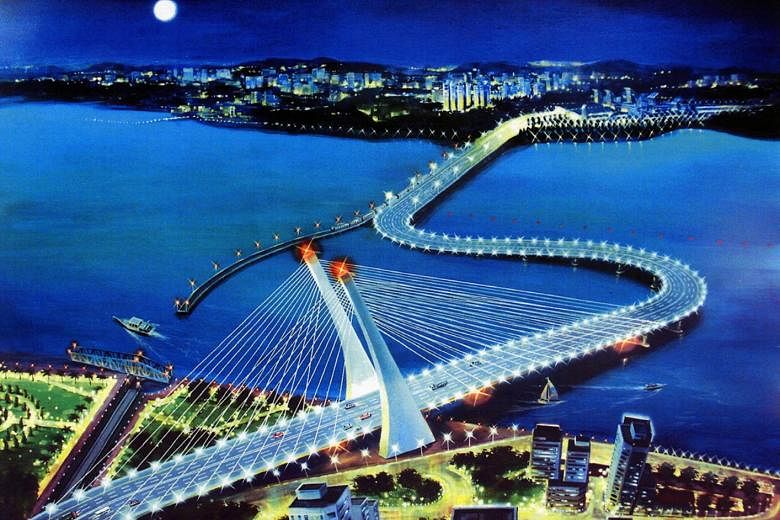
The crooked bridge project was mooted by Malaysian Prime Minister Mahathir Mohamad before he retired as premier in 2003. PHOTO: GERBANG PERDANA


For much of the past decade Singapore has had to endure demands from Malaysia's Mahathir Mohamad that the causeway connecting the two countries be replaced by what has become known as the Crooked Bridge. His resignation as prime minister of Malaysia in 2020 seems to have put that demand to rest but now it seems Singapore and its prime minster Lee Hsien Loong are being tormented by a similar demand, this time from the south,  from Australia's PM Albanese  who  demands that  Hsien Loong share his fantasy of a solar  power cable connecting Singapore and Australia. 

As this writer noted, Albanese seemed to be channeling BJ Habibie, the former Indonesian President (who is supposed to have described Singapore as a little red dot) when he told Hsien Loong at a press conference in Canberra: 

"This island continent of ours is a little bit bigger than the island continent of Singapore...... And hence, a project like Sun Cable, which has the potential to export clean energy to Singapore, is the ultimate win-win. If this project can be made to work - and I believe it can be - you will see the world's largest solar farm, you will see the export of energy across distances, the production of many jobs here in Australia, including manufacturing jobs".

Hsien Loong said nothing in response, and that is to be expected for  Hsien Loong, his government, and the relevant authorities have yet to provide Sun Cable any approvals whatsoever to Sun Cable:

Infrastructure Australia says Sun Cable's Darwin-Singapore solar cable qualifies for taxpayer funding, Singapore says Sun Cable does not have permission to import electricity into Singapore


While Mahathir's insistence on the Crooked Bridge despite a lack of interest from Singapore caused local Malaysian media to investigate the motivation for the project, there has yet to be any serious investigation in Australia into Albanese's fantasy.

END