Showing posts sorted by relevance for query work experience. Sort by date Show all posts

Saturday, February 8, 2025

Will College Of Law PLT standards continue to be determined by novelist Adrian Deans, and will PLT work experience continue to be judged not by the quality of the work experience, but by the quality of the reflection of the work experience , as described by Lewis Patrick, Chief Academic Director College Of Law

 by Ganesh Sahathevan 

The public questioning of a College Of Law PLT by Chief Justice NSW Andrew Bell demands that these issues concerning the College Of Law be investigated. They have clearly affected the quality of training. 

                     
Mr Adrian Deans
The College's PLT work experience component is overseen by Adrian Dean, a novelist who does not appear to have much exposure to legal practise. 

This writer has had the experience of submitting a work experience journal to Deans, while enrolled as a PLT student at the College. The conclusion of this writer's work experience recorded in the journal was that the College taught little if anything that was applicable in actual legal practise. 


Deans objected to that submission, and requested it be changed. He was unable to defend the relevance of the College's PLT course, except to say that this writer had a "problem" with the course he oversaw. The College's academic head, Lewis Patrick attempted to justify his and Deans' position by stating that PLT students' work experience journals were judged on the quality of the reflection of the experience, and not the quality of the work experience itself.

The above occurred in 2018, when the College's conduct was overseen by the then Chief Justice OF NSW, Tom Bathurst. The above matters were brought the Bathurst's attention, and he did nothing. 

TO BE READ WITH 


by Ganesh Sahathevan


Mr Lewis Patrick 


Lewis Patrick ,  Chief Academic Officer and Deputy CEO at College of Law (COL) , has also resigned as a director of COL's UK venture, the College Of Legal Practise Ltd (COLP) . He joins Nick Savage, COLP's high profile CEO, whose resignation was reported on this blog yesterday.

The reasons for now two high profile departures are unknown; the College and in particular its CEO Neville Carter operate under a code of secrecy and have refused to answer queries about their operations. 

However, its foreign misadventures, especially in Malaysia, are now a matter of public record. Despite these public revelations the College has refused to clarify matters; CEO Carter has in fact gone so far as to portray the Malaysian experience as a plus in promoting the College's expansion into the UK. 
A similar venture in Singapore also seems to have run into problems. 

It is left to be seen how the UK market reacts to the College's uniquely Antipodean methods of instruction in legal training. For example, in his capacity as Academic Director  Patrick once famously declared that in assessing the work experience component of the Practical Legal Training (PLT) course that the College Of Law conducts in Australia " the College is not assessing the quality of (the student's) work experience, but rather the quality of (the student's) reflections on that experience

In fact, the College's Director in charge of the PLT's work experience component is one Adrian Deans, who in the past  decade has become better known as a novelist. 


Friday, November 7, 2025

Cheif Justice NSW Andrew Bell has declared the College Of Law PLT not fit for purpose- Students, graduates entitled to a refund of fees from the College,and the senior managers responsible for promoting an obviously flawed course

 by Ganesh Sahathevan 


In the words of the NSW Legal Profession Admission Board: 
PLT was designed as a bridge between completion of a law degree and entering legal practice, originally to replace articles. PLT is no longer fit for purpose.
https://lnkd.in/gcx6i_B5


It is good that the NSW LPAB has finally determined that which has been obvious for a very long time.

 Students, graduates entitled to a refund of fees from the College,and the senior managers responsible for promoting an obviously flawed course.


TO BE READ WITH 


TO BE READ WITH 


Saturday, February 8, 2025

Will College Of Law PLT standards continue to be determined by novelist Adrian Deans, and will PLT work experience continue to be judged not by the quality of the work experience, but by the quality of the reflection of the work experience , as described by Lewis Patrick, Chief Academic Director College Of Law

 by Ganesh Sahathevan 

The public questioning of a College Of Law PLT by Chief Justice NSW Andrew Bell demands that these issues concerning the College Of Law be investigated. They have clearly affected the quality of training. 

                     
Mr Adrian Deans
The College's PLT work experience component is overseen by Adrian Dean, a novelist who does not appear to have much exposure to legal practise. 

This writer has had the experience of submitting a work experience journal to Deans, while enrolled as a PLT student at the College. The conclusion of this writer's work experience recorded in the journal was that the College taught little if anything that was applicable in actual legal practise. 


Deans objected to that submission, and requested it be changed. He was unable to defend the relevance of the College's PLT course, except to say that this writer had a "problem" with the course he oversaw. The College's academic head, Lewis Patrick attempted to justify his and Deans' position by stating that PLT students' work experience journals were judged on the quality of the reflection of the experience, and not the quality of the work experience itself.

The above occurred in 2018, when the College's conduct was overseen by the then Chief Justice OF NSW, Tom Bathurst. The above matters were brought the Bathurst's attention, and he did nothing. 

TO BE READ WITH 


by Ganesh Sahathevan


Mr Lewis Patrick 


Lewis Patrick ,  Chief Academic Officer and Deputy CEO at College of Law (COL) , has also resigned as a director of COL's UK venture, the College Of Legal Practise Ltd (COLP) . He joins Nick Savage, COLP's high profile CEO, whose resignation was reported on this blog yesterday.

The reasons for now two high profile departures are unknown; the College and in particular its CEO Neville Carter operate under a code of secrecy and have refused to answer queries about their operations. 

However, its foreign misadventures, especially in Malaysia, are now a matter of public record. Despite these public revelations the College has refused to clarify matters; CEO Carter has in fact gone so far as to portray the Malaysian experience as a plus in promoting the College's expansion into the UK. 
A similar venture in Singapore also seems to have run into problems. 

It is left to be seen how the UK market reacts to the College's uniquely Antipodean methods of instruction in legal training. For example, in his capacity as Academic Director  Patrick once famously declared that in assessing the work experience component of the Practical Legal Training (PLT) course that the College Of Law conducts in Australia " the College is not assessing the quality of (the student's) work experience, but rather the quality of (the student's) reflections on that experience

In fact, the College's Director in charge of the PLT's work experience component is one Adrian Deans, who in the past  decade has become better known as a novelist. 


Monday, August 2, 2021

College Of Law Australia Masters In Legal Business case studies will be overseen, perhaps scripted by crime & sci-fi novelist Adrian Deans, Director Academic Policy & Quality -Students can expect to be judged by the quality of their reflection of their MLB experience, rather than the quality of their analysis

 by Ganesh Sahathevan 


The College Of Law "Australia" has been aggressively marketing a Masters In Legal Business. The course advertising promises that students will learn through case studies.  


It is unclear  where this pool of case studies will come from but it is known that the College's Director, Academic Policy & Quality, is better known for his work as a crime and romance novelist. While his College of Law profile states: 


Mr Adrian Deans


(Secretary) Director, Academic Policy & Quality, The College of Law

BA LLB (Macq); LLM (Sydney); Grad Cert in University Teaching and Learning (CSU); Solicitor of the Supreme Court of NSW

Adrian Deans is a legal practitioner with over 20 years experience in College management and academic governance. He is a former member of the NSW Dept of Education & Training Accreditation Panel, a former AUQA Auditor, and has been a member of the TEQSA Panel of Experts; 


 Deans says in is words:

Hello, I’m an Australian writer, mainly known for my off-beat crime novels but have also produced an historical fiction story, and am just about to have my first sci-fi novel published. If there is a unifying theme to all my work, I guess you might say that there is a splash of surrealism in everything I do. It’s been said by reviewers that I “see the oddities and imperfections that others miss.” I write about the extraordinary within the ordinary, the illogicality of accepted norms and the life that happens between the cracks. My most recent book is Welcome to Ord City – a satirical crime novel set against the backdrop of Australian refugee politics. My next book is Asparagus Grass – a sci-fi novel about the real reason the Earth is such a screwed up place.


This writer has had the experience of submitting a work experience journal to Deans, while enrolled as a PLT student at the College. The conclusion of this writer's work experience recorded in the journal was that the College taught little if anything that was applicable in actual legal practise. 


Deans objected to that submission, and requested it be changed. He was unable to defend the relevance of the College's PLT course, except to say that this writer had a "problem" with the course he oversaw. The College's academic head, Lewis Patrick attempted to justify his and Deans' position by stating that PLT students' work experience journals were judged on the quality of the reflection of the experience, and not the quality of the work experience itself.

TO BE READ WITH 


by Ganesh Sahathevan


Mr Lewis Patrick 


Lewis Patrick ,  Chief Academic Officer and Deputy CEO at College of Law (COL) , has also resigned as a director of COL's UK venture, the College Of Legal Practise Ltd (COLP) . He joins Nick Savage, COLP's high profile CEO, whose resignation was reported on this blog yesterday.

The reasons for now two high profile departures are unknown; the College and in particular its CEO Neville Carter operate under a code of secrecy and have refused to answer queries about their operations. 

However, its foreign misadventures, especially in Malaysia, are now a matter of public record. Despite these public revelations the College has refused to clarify matters; CEO Carter has in fact gone so far as to portray the Malaysian experience as a plus in promoting the College's expansion into the UK. 
A similar venture in Singapore also seems to have run into problems. 

It is left to be seen how the UK market reacts to the College's uniquely Antipodean methods of instruction in legal training. For example, in his capacity as Academic Director  Patrick once famously declared that in assessing the work experience component of the Practical Legal Training (PLT) course that the College Of Law conducts in Australia " the College is not assessing the quality of (the student's) work experience, but rather the quality of (the student's) reflections on that experience

In fact, the College's Director in charge of the PLT's work experience component is one Adrian Deans, who in the past  decade has become better known as a novelist. 


Sunday, April 14, 2019

Bar Council Malaysia & College Of Law Australia on-line Masters students not protected: College does not have real presence in Malaysia,and Australian regulators including the Attorney General NSW will act to protect it from complaints made in Australia

by Ganesh Sahathevan


Stephanie Booker, another (College Of Law )  PLT student, questioned whether ‘practical legal training’ is an accurate term. “[My course] certainly taught me where to look for things that I may need — rules, areas of law... As for helping me to apply these rules, there is a huge difference between the reality of my workplace and the comfort of my PLT course. For example, I find that the way I draft letters for [my course] is not acceptable in my workplace, and vice versa.”
(from  Malaysian Bar Council "menu" candidate Roger Chan continues to stonewall queries about his promotion of an Australian "Practical Masters", despite obvious problems)


The mystery surrounding the  Bar Council & College Of Law Australia's Master of Laws (Applied Law) in Malaysian Legal Practice grows.The link  at the course website

https://www.collaw.com/about/our-partners/bar-council-malaysia  for the  course no longer works.Readers can see for themselves by clicking the links The Master of Laws (Applied Law) in Malaysian Legal Practice " and "Find out more about our Malaysian LLM programme" located in this paragraph:

MASTER OF LAWS (APPLIED LAW) IN MALAYSIAN LEGAL PRACTICE
The Master of Laws (Applied Law) in Malaysian Legal Practice is designed to meet the needs of the Malaysian legal profession for higher level, practice-based skills acquisition across a range of specialised practice areas. It has been developed by The College of Law in collaboration with Bar Council Malaysia. Find out more about our Malaysian LLM programme.

Consequently it is hard to say if YA Daryl Goon still endorses the course,which does not appear to have the approval of the Legal Profession Qualifying Board (see story below).

Meanwhile, a new website has emerged at this link:
https://www.collaw.com/learnwithus/our-programs/postgraduate-applied-law-programmes/llm-malaysia

A course handbook can be downloaded at the link Download the Malaysian LLM Handbook. YA Goon's name is no longer  listed among the experts who have contributed to the course.

All of the above raises the question:Who can Malaysian lawyers sue if they are not happy with the course? Fees are estimated to be around RM 10,000 per subject,so this will not be a cheap exercise.Total cost are likely to be in RM80,000-RM 100,000 range.

Course delivery is entirely on-line, and this writer can tell from personal experience that the College's IT systems are prone to failure. Complaints are not welcome and in this writer's experience are regarded as a form of harassment,threat and intimidation.


The College is supervised by the Legal Profession Admission Board  (LPAB) which ultimately reports to the Attorney General New South Wales, Mark Speakman SC.

This writer's investigation into the College's business which was prompted by his own experience with poor teaching and infrastructure in the College's local on-line Professional Legal Training program which is compulsory for all lawyers seeking admission in New South Wales,has met with a hostile reception from the LPAB and Speakman. 
The investigation into the business of the College as it expands into Malaysia has been met with official findings of misconduct, in this writer's  work as a journalist.

The LPAB and AG's findings of misconduct include a finding that this writer's referral of queries to then  Attorney General Malaysia  with regards its business in Malaysia are  grounds for a finding that this writer is not fit and proper for admission to practice. 

The College's basic Practical Legal Training course from which its teaching methods for all its other courses are derived, has been found to be not very useful in practice, as reported in the Australian industry paper Lawyers Weekly in 2006. The College's PLT includes work experience at  a law firm,after which students are required to submit a journal of their work experience and explain how what was learnt at  the College was applied at work. This writer's report that the College's lessons were of no use at work was rejected and in correspondence with this writer the College's  Chair  Of Academic Studies, Lewis Patrick  said:

Please note that in assessing your work experience journal the College is not assessing the quality of your work experience, but rather the quality of your reflections on that experience. 

Malaysian lawyers can determine for themselves if this is the standard by which they would like their practical experience to be judged,in a course with the emphasis on the practical.


In Kuala Lumpur the College operates out of a virtual office and all queries sent the College Of Law Asia (or College Of Law Asia Pacific) Director Peter Tritt,  have been ignored.

The queries included claims by the College that it had in 1985 or thereabouts, under contract with the MARA Law School, produced the inaugural Legal Practice Handbook with instructional details, materials and resources for Malaysian law and practice. A query was sent the Registrar Federal Court Malaysia, requesting a copy.The  Registrar has responded via her Chief Librarian who says:

Please be informed on the revision of the Web OPAC System in Palace of Justice Library, the material is not in our collection.

I have also referred to the librarians network at 12 Law Libraries in Malaysia as well as the National Library of Malaysia. However, it is regretted that the material is not in their possession.


The issues above add to the normal  issues of cost and inconvenience of suing is foreign jurisdiction. Unsatisfied College customers from Malaysia would be obviously better off suing the College in Malaysia, but as mentioned above, they will find nothing to which they can attach judgement.

It is up to the Bar Council Malaysia and the Minister For Education to insist that the College have a physical presence in Malaysia, just like all other Australian colleges and universities offering courses in Malaysia. Their physical presence in Malaysia provides provides a limited assurance that they will provide what they promise.

Additionally,as reported on this blog the tertiary education standards regulatory board,TEQSA, cannot be relied on to ensure standards are maintained: 


Australia's education sector putting money ahead of standards :The trend continues, aided and abetted by TEQSA


END 


Saturday, Augus8, 2018


YA Daryl Goon , the Malaysian Applied Law LLM ,and YAA Richard Malanjum

by Ganesh Sahathevan


MASTER OF LAWS (APPLIED LAW) IN MALAYSIAN LEGAL PRACTICE


This writer has spent much time this week, and the last praying that the newly appointed Yang Ariff Daryl Goon might condescend to explain why he has has endorsed something called the Master of Laws (Applied Law) in Malaysian Legal Practice.

Goon has been asked to explain given the fact that this LLM (and indeed no others) have been approved by the Legal Profession Qualifying Board..

The Malaysian Bar Council seems to have played some part in promoting the course (see below) but its President and Secretary have refused numerous requests  for information about what

approvals if any the Malaysian Bar Council had obtained to promote the course in Malaysia.

The course website , hosted by the private college in Australia that manages the course (with a faculty of one person) shows prominently the Bar Council's logo. YA Daryl Goon is listed among its advisers. 

The private college also claims that it produced in 1985-86 the first group of "elite" law graduates from MARA who were admitted to practice in Malaysia. This does come as a bit of surprise to this writer and others like him who know and know of Malaysian lawyers who graduated from MARA in the 1970s. In the latter category (for I do not know him personally) is the current Chief Justice , YAA Tan Sri Richard Malanjum, who graduated in 1973.
One hopes that the newly minted YA will at least  have an explanation for his YAA. 

END


The questions (see below) remain despite this promotion by the Bar Council Malaysia:

e
Circular No 147/2017
Dated 11 July 2017n 
To Members of the Malaysian Bar
Providing Assistance to The College of Law, Australia | Development of Localised Master
of Laws Programme
The Bar Council Malaysia has signed a Memorandum of Understanding with The College of
Law, Australia and New Zealand in order to create further legal education and training platforms
for the benefit of Members of the Bar.
In this regard, The College of Law is interested to localise the content of its existing Australian
Master of Laws (“LLM”) in Applied Law programme for Malaysia, and is interested in working
with Members of the Bar who have relevant legal research and writing, and practical legal
experience. This is to be carried out on a project basis, and the Members will be remunerated.
The first six subjects in this new LLM programme are near completion and will be offered in
September 2017 as part of a new LLM (Applied Law) with a major in Malaysian Legal Practice.
The next 11 LLM subjects that The College of Law is interested in localising are listed below:
(1)
Advocacy;
(2)
Alternative Dispute Resolution Practice;
(3)
Arbitration.
(4)
Banking and Finance;
(5)
Family Law Practice;
(6)
Intellectual Property Practice;
(7)
Islamic Banking and Finance;
(8)
Mediation;
(9)
Mergers and Acquisitions Practice;
(10) Negotiation; and
(11) Wills, Estates and Trusts.
If you are interested in pursuing this opportunity, please send your expression of interest together
with your detailed resume and any queries, directly to:
Peter Tritt
Director | Asia-Pacific
The College of Law Australia and New Zealand
Level 23, Nu Tower 2
Jalan Tun Sambanthan,
50470 Kuala Lumpur
Mobile: +6013 305 7660
Thank you.
Roger Chan Weng Keng
Secretary
Malaysian Bar


Saturday, February 15, 2025

The Chief Justice NSW Andrew Bell's public condemnation of the College Of Law PLT provides an avenue for PLT students to seek a refund -PLT course and certificate are worthless without the Chief Justice's imprimatur

 by Ganesh Sahathevan 

                         Andrew Bell has been described as ‘one of the most brilliant in a generation’


The College of Law Australia's  Practical Legal Training (PLT) course  has been condemned  by the  Chief Justice NSW Andrew Bell, for offering a PLT course that is not worth the money. Bell has now embarked on a campaign to reform the PLT. 


Bell is not only Chief Justice but also chairman of he MSW Legal Profession Admission Board that accredits  the College as a PLT provider so it is not surprising that Bell's outburst has caused others to offer their own frank assessment of the College's PLT.


Senior practitioners and recent graduates from the 15-week practical legal training course, which requires only five days of in-person attendance and is taught mostly online, criticised its lack of rigour and utility.

They acknowledged a normalisation of cheating by sharing past answers to recycled exam questions and deploying ChatGPT to generate responses.


One junior lawyer, who completed the course last year and now works in the public sector, said prior fees of up to $12,000 were “transparently extortionate, and everyone knows that’s going in. It’s a necessary prerequisite for admission, and students know they won’t gain anything from it”.


“I didn’t feel like I was getting value for money once. Coming from university where academic rigour was held in high regard, to be paying for mundane and reductive online tasks felt like a slap in the face. In order to justify that price, the standard should be a lot higher,” said the lawyer, who asked for anonymity to speak more freely. 

Another junior lawyer, who paid for the course themselves and now works at a community legal centre, said staff did little to combat students’ dim view of the course.

“There’s kind of this unspoken vibe between teachers and students that it’s all pretty bullshit,” they said.

“Written assessments follow the same formula for every subject … but no one puts any effort into them. People either copy someone else’s [answers] or use ChatGPT.

“You can upload the course documents to ChatGPT and ask it to write a letter of advice. I did that and passed everything.”

In light of the above PLT graduates have now a certificate that cannot be said to add anything to their professional standing and if anything embarrasses them. It follows that PLT graduates and students are entitled to recovery of their fees.The College should in fact be providing past and current students with proposals for refund of fees paid for services that were obviously not of the standard promised. Failure to do so, very soon, can be remedied by a class action. 

Complaints about the College's PLT are not new, but the College and its senior managers have always enjoyed the protection of their Chief Justice, which has allowed them to act with impunity.

TO BE READ WITH 


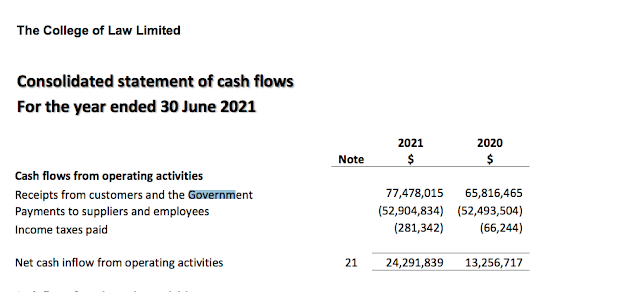
Government funding for the College Of Law PLT where students are assessed on the quality of their reflection on their work experience , not the quality of their work experience

 by Ganesh Sahathevan 

The above has been extracted from the latest College Of Law Ltd's annual report. The substantial government funding is provided via the Commonwealth's FEE HELP facility. 

The Practical Legal Training (PLT)  which the College runs, and which is a prerequisite for admission to practise  in NSW, has the imprimatur  of the Chief Justice NSW, Tom Bathurst, in his capacity as Chairman of the the NSW Legal Profession Admission Board. 

College Academic Director Lewis Patrick has said that in assessing the work experience component of the PLT  " the College is not assessing the quality of (the student's) work experience, but rather the quality of (the student's) reflections on that experience.


The College's PLT course is now mostly on-line, and there are problems with delivery and infrastructure. Its FEE HELP cashflow is being utilised to finance its expansion overseas.


TO BE READ WITH 


by Ganesh Sahathevan


bar council
Very many questions remain unanswered with regards the College Of Law's joint venture with Malaysia's Bar Council.


UK's The Lawyer reported recently that the College Of Law Sydney has decided to break into the UK market, to"battle BPP and ULaw for super-exam supremacy".


Quoting College CEO Neville Carter The Lawyer reported:
“The hallmark of the Australian model is delivery of learning directly into the workplace within a very flexible framework of work placement. The model drives access to the legal services market and fuels the growth of employment opportunities. We believe that the reforms in England and Wales provide an opportunity for us to share what we have learnt in Australia and across Asia and assist in shaping new models and pathways in England and Wales.”


Carter has yet to explain his exaggerated claims of having reformed Malaysian legal practise in the mid 80s; in fact the College's latest venture into Malaysia seems to have ended in failure, again leaving many unanswered questions.
The College has refused to explain why its website dedicated to its "LLM" in Malaysia no loner works, nor has it been replaced with anything similar.

As previously reported, the College seems to have a tendency to invest its mainly government funded revenue in vanity projects in  exotic locations at the expense of its core business of providing the Professional Legal Training course that must be completed by anyone seeking admission to practise in NSW

Complaints against the College are ignored by its regulator, the NSW Legal Profession Admission Board, which is chaired by the Chief Justice of NSW,who considers it the height of bad behaviour to question the relevance and  quality of the College's teaching standards, despite students here having to normally take on a debt of about AUD 10,000 to pay for about 3 months worth of on-line learning, most of which is self taught with minimal input from instructors.
END